Innovation Mode 2.0: The Chief Innovation Officer's Blueprint for the Agentic AI Era
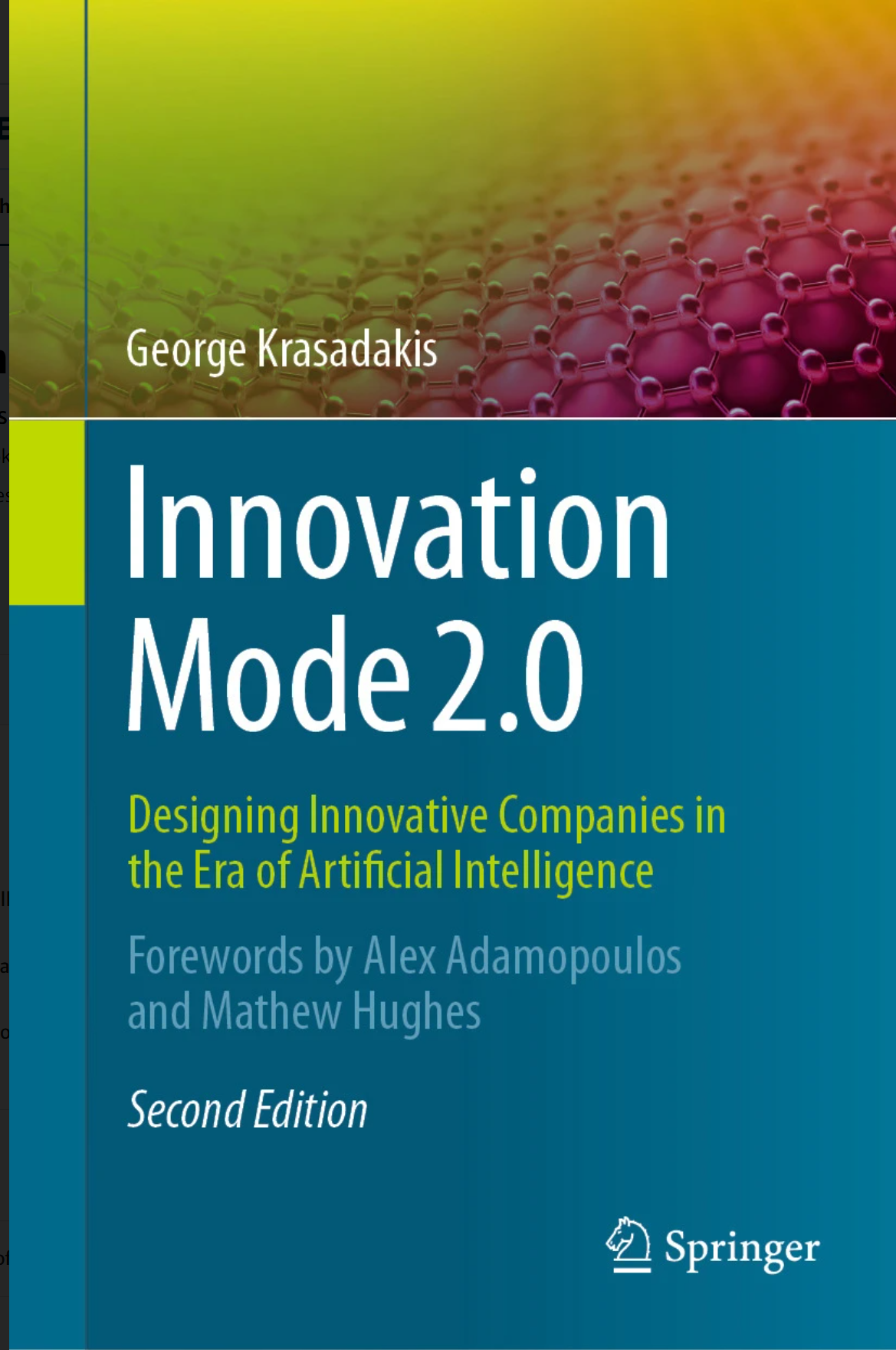
Innovation Mode 2.0
The practitioner's blueprint for autonomous, AI-powered innovation—featuring diagnostic frameworks, a phased transformation roadmap, and ready-to-implement tools and agentic AI patterns.
Not theory. Actionable advice, architectures and organizational designs.
Springer | January 2026 | 340 pages | 11 chapters | Available on Amazon
When AI can generate hundreds of ideas before your team finishes one meeting, the rules of corporate innovation change entirely.
Six years ago, George Krasadakis closed the first edition of Innovation Mode with a prediction: "In a fully digitized environment powered by Artificial Intelligence, the focus shifts from running the business to pursuing opportunities. In the organization of the future, humans will play a substantial role in forming opportunities through business creativity."
That future is now here.
Today, as the second edition arrives from Springer, the prediction has become reality—and most companies are dangerously unprepared. BCG's 2024 innovation study delivers a sobering verdict: 83% of companies rank innovation as a top priority, yet just 3% are ready to deliver.
Innovation Mode 2.0: Designing Innovative Companies in the Era of Artificial Intelligence isn't another book about innovation theory. It's an operating system for the Chief Innovation Officer navigating the most disruptive transformation corporate innovation has ever faced.
Innovation Disrupts Itself
Here's the paradox that keeps innovation leaders awake at night: AI doesn't just enable faster innovation—it fundamentally impacts the innovation function itself.
When artificial intelligence can generate brilliant ideas, shape strategies, and build digital prototypes within minutes, the traditional value proposition of corporate innovation teams evaporates. As Krasadakis writes in the new preface: "AI joins the innovation effort not only as a thought partner helping human innovators shape ideas but also as an extraordinary innovator, capable of generating ideas and product concepts, building prototypes, and shaping strategies within minutes."
The implications are profound. Innovation cycles that once took months can now collapse to days. What took days will soon take hours. And the companies that thrive won't be those with the best ideas—they'll be those with the architecture to systematically discover, validate, and realize opportunities at scale.
That architecture is precisely what this book provides.
Beyond Theory: A Practitioner's Framework Built on 25 Years in the Trenches
What sets Innovation Mode 2.0 apart from the flood of AI-and-innovation titles crowding bookstore shelves? The author's rare combination of credentials.
George Krasadakis has spent 25 years building innovation labs, centers, venture teams, and programs from scratch across 20+ global organizations—as innovator, inventor, innovation leader, and innovation architect. Senior roles at Microsoft, Accenture, GSK, and ResMed. Four corporate innovation centers architected. 80+ technology projects delivered from concept to launch. 20+ patents in AI and machine learning, including AI-powered brainstorming agents and autonomous innovation systems filed years before ChatGPT existed.
This isn't a professor theorizing about what might work. It's a practitioner sharing what actually does.
And crucially, Krasadakis doesn't just write about autonomous AI innovation—he's building it. His current venture, Ainna.ai, is a working autonomous innovation agent that discovers opportunities, validates them through AI expert panels, and generates complete venture documentation. The book's frameworks aren't speculative. They're battle-tested and deployed.
The Architecture of AI-Powered Corporate Innovation
The book opens with diagnosis, not prescription. After decades watching innovation programs fail—even when resources and intentions were aligned—Krasadakis identified six primary deficits that explain why corporate innovation stalls:
The Leadership Deficit: Executive blind spots, symbolic commitments, leadership that delegates innovation without participating.
The Organizational Design Deficit: Silos, hierarchy, ambiguous ownership that trap ideas between departments.
The Capabilities Deficit: Missing infrastructure to move from concept to prototype to scale.
The Real-World Connection Deficit: Disconnection from customers and markets; innovation built on assumptions.
The Talent and Culture Deficit: Missing skills plus cultures that penalize experimentation.
The Venture Building Deficit: The commercialization gap where validated concepts never reach market.
Most innovation books skip this diagnostic work and jump straight to solutions. But as any experienced Chief Innovation Officer knows, the wrong intervention at the wrong stage doesn't just fail—it sets you back.
The Innovation Maturity Index: Where Does Your Company Actually Stand?
One of the book's most valuable contributions is the Innovation Maturity Index—a structured framework that positions organizations across seven levels, from Innovation-Inactive to Innovation-Native.
At Levels 1-3, there's no systematic process; leadership talks innovation but doesn't resource it. Levels 4-5 bring dedicated leadership, active communities, and measurement—most companies stop here. At Levels 6-7, innovation becomes AI-powered and embedded in core operations. At Level 7, innovation is no longer a distinguishable function; it's seamlessly integrated into essential business processes, powered by AI systems that provide market intelligence, contribute ideas, and validate opportunities autonomously.
The destination is clear. The masterplan of 70+ interventions—each mapped to the appropriate maturity level—shows exactly how to get there.
Three Capabilities That Define the AI-Powered Innovation Function
The heart of the book presents what Krasadakis calls the first published architecture for autonomous corporate innovation: three AI-powered capabilities working in concert.
Autonomous Opportunity Discovery: AI agents that scan markets 24/7, detect weak signals, identify emerging trends, and generate business concepts—without human prompting. Environmental sensing meets multi-agent ideation. This isn't about replacing human creativity; it's about augmenting human judgment with machine-scale pattern recognition across the entire market landscape.
AI-Powered Validation: Concepts evaluated through simulated panels of AI personas—representing customers, investors, domain experts, and critics—before human review. Rapid, scalable assessment that surfaces the most promising ideas while filtering noise.
Accelerated Realization: From validated concept to working prototype in hours, not months. AI-assisted product definition, technical architecture, and execution-ready documentation—compressing the path from idea to market.
Together, these capabilities form what Krasadakis describes as "a scalable opportunity discovery, validation, and realization function—a system of talented cross-disciplinary teams powered by AI that can pursue multiple opportunities simultaneously."
The Existential Question for Innovation Leaders
The book doesn't shy away from the uncomfortable implications of its own thesis. When AI generates remarkable ideas in seconds and functional prototypes in minutes, human innovators question their ability to contribute. This isn't just process disruption—it's a threat to identity, self-esteem, and psychological wellbeing.
Krasadakis addresses this head-on, exploring how organizations can navigate the culture shock of AI-powered innovation without losing their best people. The future, he argues, belongs to a new breed of professional: the intrapreneur—autonomous, entrepreneurial individuals who make wise investment decisions and drive adoption. Traditional innovation roles are fading; the intrapreneur profile becomes essential.
"Not Just a Book, But a Blueprint"
The forewords from Alex Adamopoulos (CEO, Emergn) and Dr. Mathew Hughes (Professor of Innovation & Entrepreneurship, University of Leicester) frame the book's significance.
Adamopoulos writes:
"Innovation Mode 2.0—not just a book, but a blueprint for what it really takes to build innovative companies in today's world—companies that don't just talk about innovation but live it in their culture, in their systems, and in their everyday decisions."
Hughes adds:
"An excellent overview and reference point about people, culture, and capabilities as the key pillars of innovation and practical ways to discover, validate, and realize opportunities on the road to innovation."
Why This Book, Why Now
We live at an inflection point. As Krasadakis observes: "Corporate innovation shifts from nice-to-have to existential capability."
Emerging agentic AI isn't just augmenting how work is done—it's starting to shape what work gets done, how decisions are made, and what gets prioritized. AI can scan for opportunities, test assumptions, even generate product roadmaps. But AI can't tell you what's worth fighting for. It can't build trust. It can't rally a team around a shared sense of purpose.
That still falls to human leaders. And those leaders need a new playbook.
The companies that operate in "Innovation Mode" aren't just more agile or more digital. They are more human. They listen better. They adapt faster. They serve more meaningfully. And in the long run, they win.
Innovation Mode 2.0 is that playbook—comprehensive, practical, and built for the world that's arriving faster than most organizations realize.
Book Details
Innovation Mode 2.0: Designing Innovative Companies in the Era of Artificial Intelligence By George Krasadakis Springer, January 2026 340 pages | 11 chapters | 75%+ new content
ISBN (Hardcover): 978-3-032-00834-3 ISBN (eBook): 978-3-032-00835-0
Available now from: Springer | Amazon | Major booksellers worldwide
About the Author
George Krasadakis is an innovation architect and AI strategist with over 25 years of experience spanning startups and global corporations. He has held senior innovation leadership roles at Microsoft, Accenture, GSK, and ResMed, and has architected four corporate innovation centers. A five-time entrepreneur with successful exits, George holds 20+ patents in artificial intelligence and related technologies. He is the creator of the 60 Leaders series on Innovation and AI, and founder of Ainna.ai—the autonomous innovation agent that proves AI-powered innovation isn't theory, it's here.
Connect: LinkedIn | theinnovationmode.com | Ainna.ai
For media inquiries, review copies, or interview requests: george@theinnovationmode.com