
60 Leaders on Artificial Intelligence
17 essential questions on AI — answered by 60 global leaders across technology, research, ethics, and policy. The questions that still don't have easy answers.
The AI Revolution — Through 60 Different Lenses
Sixty researchers, engineers, ethicists, executives, and policy experts. One book. The same 17 questions about AI's impact on business, society, employment, democracy, and the future — each answered through a different lens. 60 Leaders on Artificial Intelligence was assembled in 2022, ahead of the generative AI wave that made these questions urgent. The work has only become more relevant since.
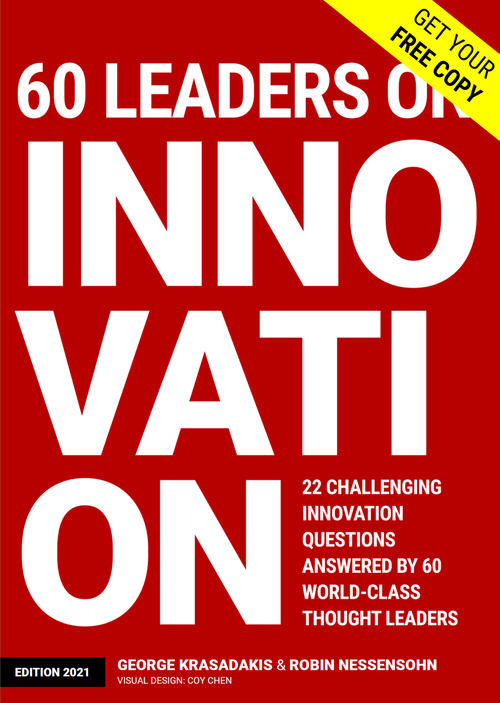
The result is 240+ pages of unfiltered perspectives on AI strategy, ethics, employment, governance, geopolitics, and the nature of intelligence itself. Written before the current wave, the core principles and philosophies are even more relevant now — because the questions these leaders answered in theory are the ones organizations are now confronting in practice. The companion volume, 60 Leaders on Innovation, applies the same format to corporate innovation.
Produced by George Krasadakis — author of Innovation Mode 2.0 (Springer, 2026), holder of 20+ AI patents, and founder of Ainna.ai — a project made of pure passion for AI from 60+ people across the globe.
The Leaders Behind the Insights
60 global leaders — researchers, engineers, executives, ethicists, and policy experts. Including:
The Questions That Define the AI Era
From explaining AI to a 5-year-old to asking whether AI could replicate itself — each question is answered by multiple leaders with diverse, sometimes conflicting perspectives.
No questions in this topic.
How would you explain AI to a 5-year-old?
AI is about getting machines to complete complex tasks through trial and error — learning from mistakes until they get it right. The simplest explanation is often the most revealing.
What is the essential curriculum for a career in AI?
AI is inherently interdisciplinary. A great AI scientist comprehends interrelated disciplines — from statistics and linear algebra to domain expertise and data storytelling.
What is the most impressive task AI can accomplish today?
From automatically generated poetry to drug target identification — but the most impressive task AI can accomplish is yet to come, and it will deal with human health.
How is AI impacting the way businesses operate?
AI is key in the evolution from data-driven to discovery-driven enterprise. But it's naive to think efficiency improves just by adopting AI tools — you need the organizational architecture and the right discovery tools to match.
How could a company transform into an AI-powered organization?
Transforming into an AI-first organization is an ongoing journey, not a project. Data democratization is achieved when data is used in regular decision-making — supported by the right organizational design. AI-powered strategy tools now make this transition faster than ever.
Do companies need a Chief AI Officer?
The CAIO is responsible for driving tremendous organizational change — sharing the AI vision, driving adoption, and connecting teams. CDO and CAIO should not be interchangeable roles — much like the Chief Innovation Officer.
What is the AI state of the art?
Quantum computing holds great potential and could cause a real step-change. AI on quantum computers will make breakthroughs in solving some of the world's most pressing problems.
What is AI's impact on our societies and everyday life?
Since the efficiency gained from AI is huge, the inequality it creates is also extreme. It is of critical importance that we retain the human capacity to imagine and dream.
What is the impact of AI on employment?
Humans who master math and coding will have job security for the foreseeable future. But large-scale job displacement in the short term is a problem we must address — not dismiss.
How should societies get prepared for AI?
General awareness programs should dispel the myths around AI. A vital component of readiness is training domain experts — not just data scientists — to work with AI systems.
What are the ethical concerns of AI?
Without intervention, AI algorithms can learn, codify, and perpetuate biases long into the future. What scares us is not driving fast — it's driving fast while blindfolded.
How do we prevent the concentration of AI power?
To draw AI talent, provide meaning and purpose beyond just compensation. It is extremely difficult for small companies to attract AI talent — and that imbalance shapes the entire ecosystem.
To regulate or not? How should governments react to AI?
We should not expect technology companies to have humanity's best interest at heart. But it is difficult to regulate something when its capabilities are evolving and hard to predict. Patent architectures offer one framework.
How could democracy benefit from AI?
If applied mindfully, AI can significantly foster democratic processes. But expecting an ML algorithm to become a magic truth detector might be naive.
Can AI help solve climate change?
Innovation is what will help organizations bring emissions to the required level. AI and sustainability research must join forces — now is the right time.
How is AI changing the global geopolitical system?
AI will rebalance power between states, upend traditional economic models, and transform the nature of warfare. AI technology will be the defining geopolitical issue in the coming decades.
Download Your Free Copy
240+ pages on AI from 60 global leaders. No paywall. No registration. Just the PDF.
This is an independent project — not an Innovation Mode initiative. George Krasadakis conceived and led it in 2022. The sixty contributors took part on their own, as individual thought leaders, not representing their companies, with no affiliation to Innovation Mode. This is one of many copies in circulation. Readers are welcome to share.
More from Innovation Mode
Innovation Mode 2.0
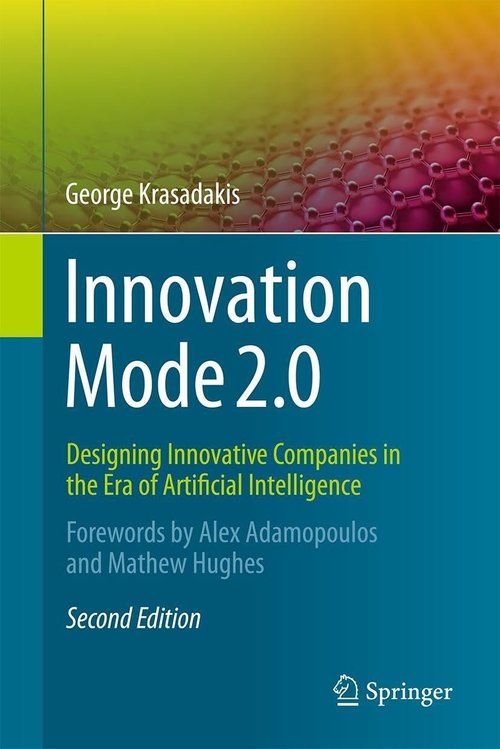
The executive operating manual. 70+ interventions, 6 Innovation Deficits diagnostic, 7-level Maturity Index. Springer, 2026.

60 Leaders on Innovation
The companion volume. 22 questions on corporate innovation answered by 60 global leaders. 286 pages. Free.
Innovation Dictionary
60+ terms — including AI strategy, AI readiness, design thinking, and innovation maturity. The glossary for AI and innovation practitioners.
Societies need to adapt to the new technology landscape and embrace AI as a ‘smart tool’ that helps people to achieve more.
— George Krasadakis, from the PrefaceNeed an AI Adoption Strategy (or Portfolio)?
Two 8-week advisory programs for executive teams. Innovation Advisory rebuilds the innovation function. AI Strategy Advisory turns AI ambition into a sequenced roadmap.
Built on the frameworks of Innovation Mode 2.0 (Springer, 2026). Or explore Ainna.ai, the autonomous innovation agent.