Innovation Toolkit 4.0 · 8 Templates + IM-9 Idea Assessment

Innovation,
by the book.

Eight editable innovation templates with embedded guidance, the IM-9 Idea Assessment Model with configurable weighted scoring, and the complete frameworks documented in Innovation Mode 2.0 (Springer, 2026) — covering problem framing, ideation, scoring, validation, and workshops.

5Word Docs
2PPT Docs
1Excel Model
9Criteria

One-time payment · Lifetime access · Instant download — yours forever. Free for studentslicense for agencies available.

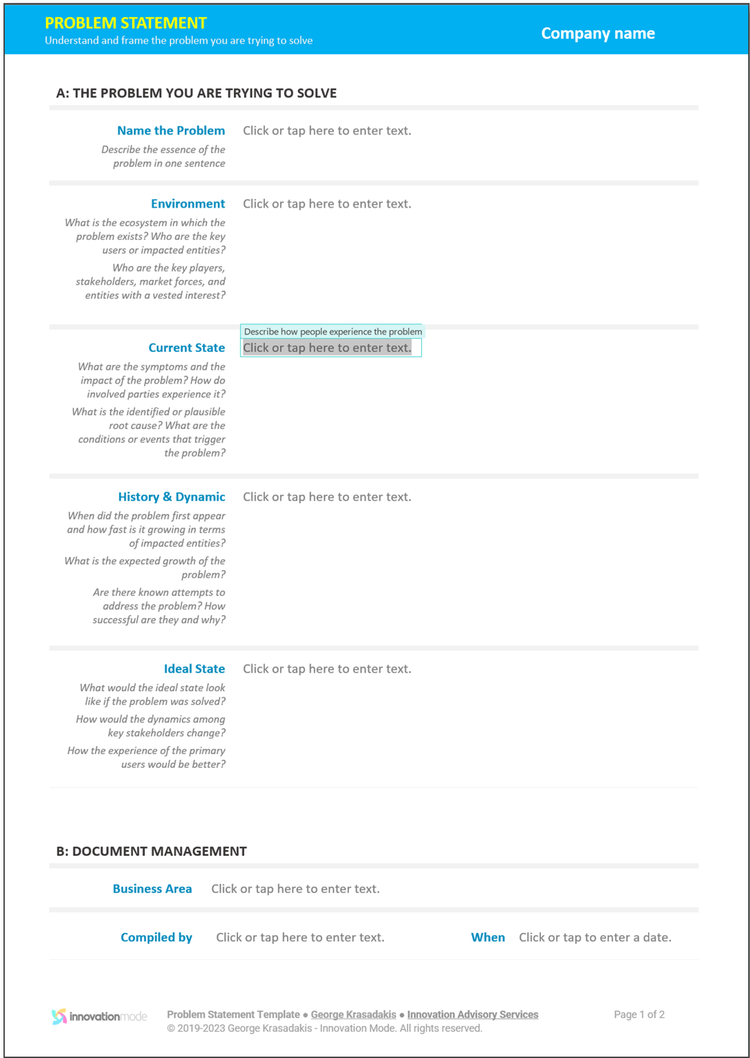
Problem Statement Template — structured one-page format
Business Idea Template — consistent format for sharing innovation ideas
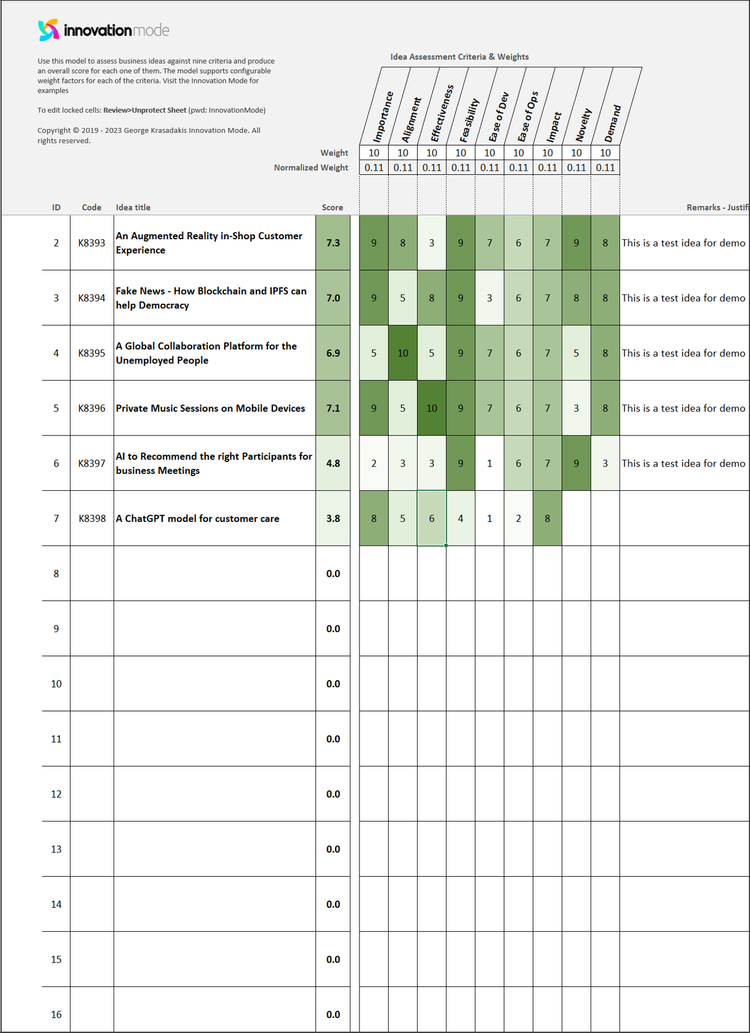
IM-9 Idea Assessment Model — Excel scoring with 9 weighted criteria
8 Templates

The same innovation frameworks used by innovation teams globally — now available as customizable templates for your team.

What's Inside

8 Innovation Templates

From defining the right problem to shipping the product concept — every template maps to a stage in the innovation process described in Innovation Mode 2.0. Created by George Krasadakis — some of the core frameworks used in innovation advisory and AI strategy engagements with global companies. Delivered as fully editable MS Word, MS PowerPoint, and MS Excel documents.

Innovation Problem Statement Template — structured format for defining business challenges
Problem Framing

Problem Statement Template

A structured one-page format for defining and communicating business problems clearly — ensuring teams tackle challenges worth solving before jumping to solutions.

MS Word · Editable
See guide & examples →
Innovation Business Idea Template — consistent format for describing and sharing ideas
Ideation

Business Idea Template

A consistent format for describing, sharing, and refining draft innovation ideas across teams and stakeholders. Based on the framework documented in Innovation Mode 2.0.

MS Word · Editable
See guide & examples →
IM-9 Idea Assessment Model — Excel scoring template with 9 weighted evaluation criteria
Evaluation

IM-9 Idea Assessment Model

The 9-dimension weighted framework from Innovation Mode 2.0 — Importance, Alignment, Effectiveness, Feasibility, Ease of development, Ease of operation, Business impact, Novelty, and Certainty of demand. Produces a single Opportunity Score per idea, with configurable Views to match your context.
MS Excel · Configurable
See the methodology →
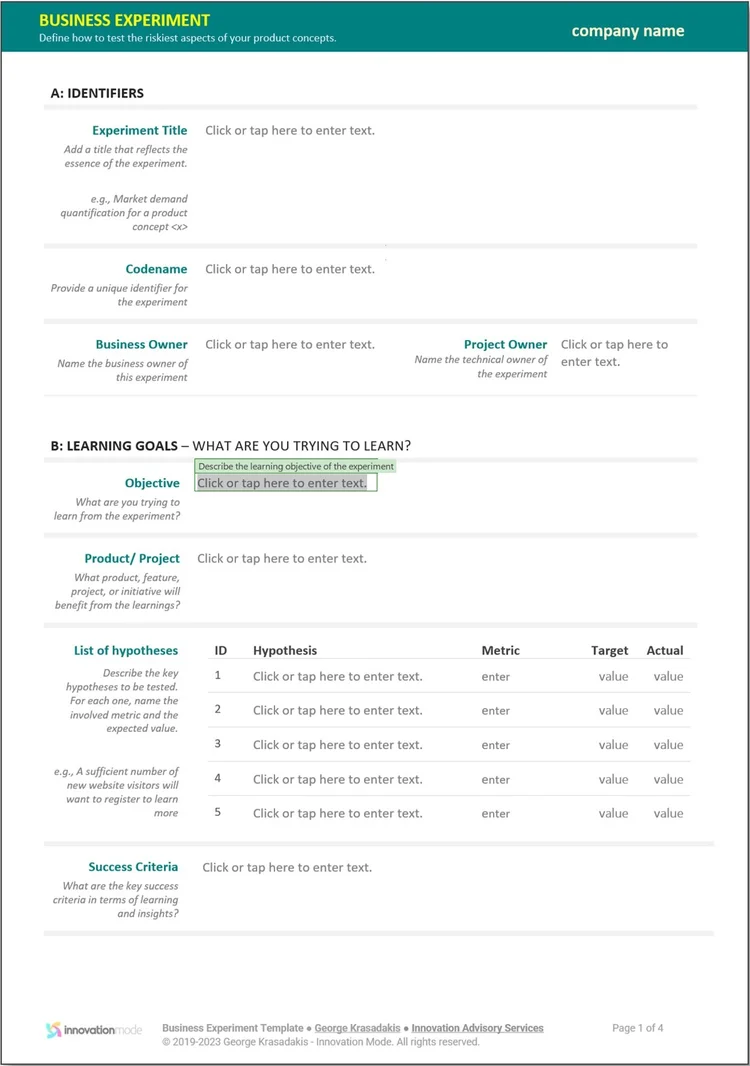
Innovation Business Experiment Template — structured framework for validating hypotheses
Validation

Business Experiment Template

A structured framework for designing controlled experiments — defining learning objectives, hypotheses, metrics, target audience, and success criteria before committing resources.

MS Word · Editable
See guide & examples →
Innovation Product Concept Template — holistic product vision framework
Product

Product Concept Template

A holistic framework for articulating a product vision — market context, competitive landscape, user personas, epic user stories, technology stack, go-to-market, and monetization strategy.
MS Word · Editable
See guide & examples →
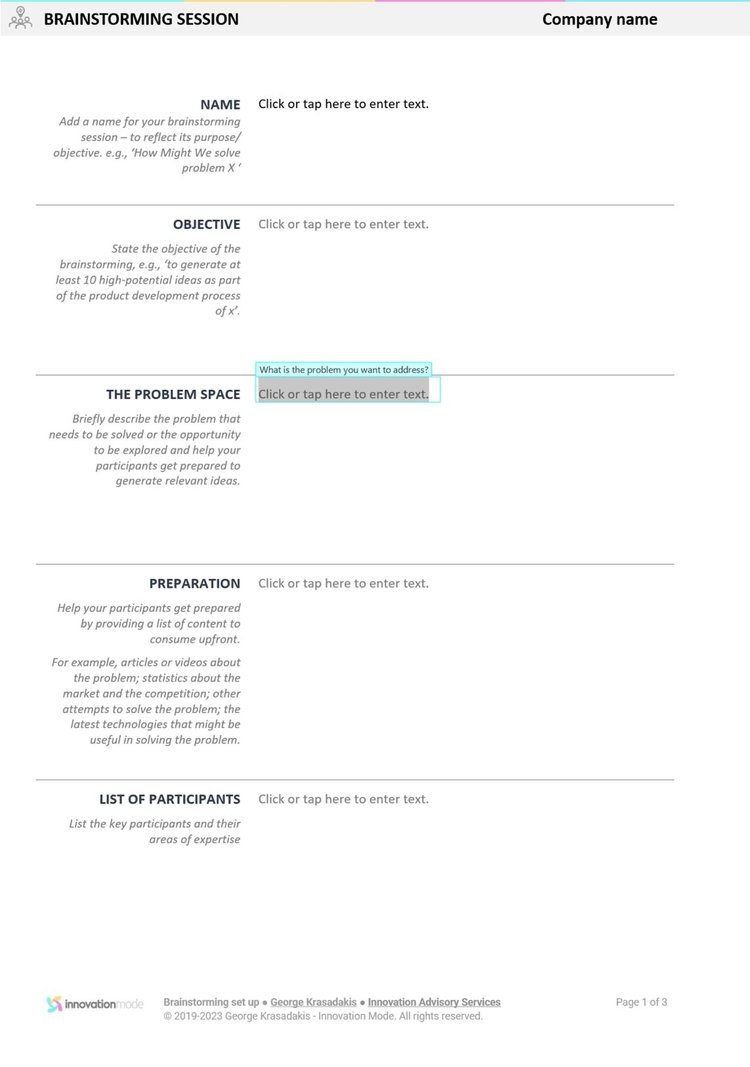
Brainstorming workshop setup template
Workshops

Workshop Setup Template

An innovation workshop template for planning and structuring brainstorming sessions — defining objectives, participants, format, timing, and facilitation approach. Ensures workshops produce actionable outputs, not just Post-it notes.
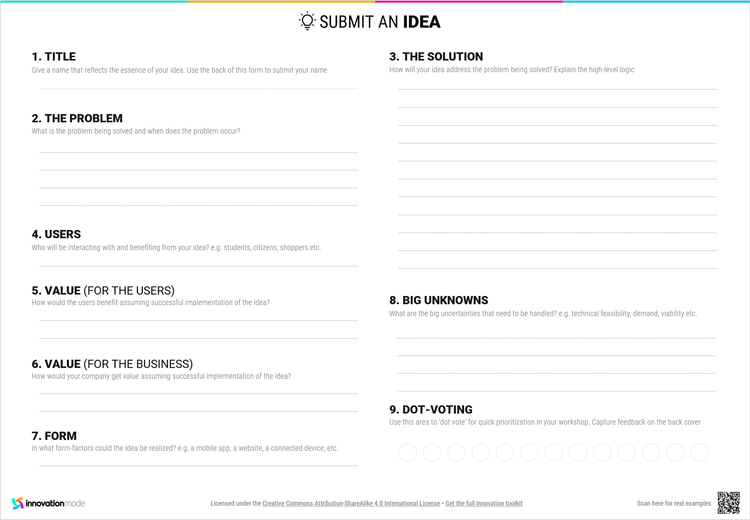
MS Word · Editable
See guide & examples →
Brainstorming idea capture template for workshop participants
Workshops

Idea Capture Template

A structured format for participants to capture and describe ideas during live brainstorming sessions — ensuring every concept is recorded consistently and ready for evaluation.
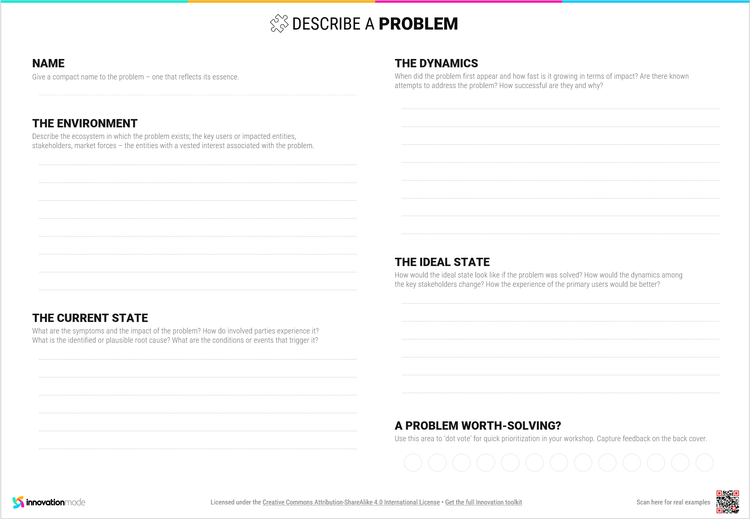
MS PowerPoint · Editable
See workshop guide →
Brainstorming problem statement framing template
Workshops

Problem Framing Template

Guide workshop participants through collaborative problem definition — breaking down challenges into structured components that teams can tackle collectively during brainstorming sessions.

MS PowerPoint · Editable
See workshop guide →
Who Uses This

Tools for Innovators. Free for Learners.

The toolkit bridges the gap between innovation theory and daily practice — giving teams a shared language and structured process for every stage of the innovation lifecycle.

For Practitioners

Innovation Managers & CINOs

Equip your teams with standardized tools for problem framing, ideation, and validation — creating consistency across business units.

For Practitioners

Product Managers & R&D Leaders

Define product concepts, design business experiments, and prioritize opportunities using structured frameworks — not ad-hoc documents.

Free Academic Access

University Professors & Lecturers

Use the toolkit in innovation, product management, and entrepreneurship courses. Free academic access — no budget approval needed.

Free Academic Access

Students & Researchers

Practice with the same frameworks used by corporate innovation teams worldwide. Build portfolio-ready deliverables using professional templates.

Why This Toolkit

Powered by published methodology

Three reasons this toolkit isn't another generic deck of templates — it's the operational layer of a documented, peer-reviewed methodology actively used in corporate innovation engagements.

Codified, Not Generic

Built on a published book

Every template maps to a stage in Innovation Mode 2.0 (Springer, 2026) — 340 pages, 70+ frameworks, including the 6 Innovation Deficits diagnostic and 7-level Maturity Index.

Practitioner-Built

From 25 years of innovation work

Created by George Krasadakis20+ AI/ML patents, 80+ products shipped across five ventures, plus advisory engagements with global companies.

Community-Tested

Refined with 60+ leaders

The methodology has been refined alongside 60 Leaders on Innovation and 60 Leaders on AI — community volumes featuring leaders at Microsoft, IBM, NVIDIA, BCG, Telefónica, Duke, ETH Zurich, and more.

Get the Toolkit

8 Templates. One Purchase. Unlimited Team Use.

Fully editable Word and Excel templates — customize, brand, and distribute across your organization. Built on the frameworks from Innovation Mode 2.0.

€199

One-time purchase · Instant download · Unlimited team use

The complete corporate innovation toolkit — problem framing, ideation, idea evaluation, business experiments, product concepts, and brainstorming workshops. Customize with your branding and distribute across your entire organization.

Buy the Innovation Toolkit · €199 →
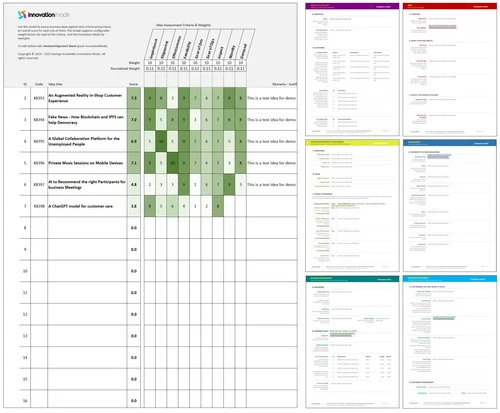
Innovation Toolkit 4.0 — 8 templates
What's Included
5 MS Word + 2 MS PowerPoint templates — fully editable
IM-9 Idea Assessment Model — Excel scoring template with configurable Views
Single ZIP file — instant download after purchase
Compatible with Microsoft 365, Office 2016+, Google Workspace
Unlimited internal use — customize, brand, distribute
Lifetime access — one-time payment, no subscription, no expiration

Students & Educators — get it free. Fill in a short form with your university email and we'll send you a coupon for complimentary access to the full toolkit.

Request Academic Access →

Consultant or agency planning to use this with clients? Email us about agency licensing.
Innovation Mode 2.0 book

The methodology behind the templates. Every template in this toolkit maps to the frameworks in Innovation Mode 2.0 — the complete practitioner's guide to building AI-powered innovation functions. The book provides the why and the when; the toolkit provides the how.

Template Guide

What's in Each Template

Detailed descriptions of every template in the Innovation Toolkit 4.0 — what it does, why it matters, and how it fits into the innovation process.

What is the Problem Statement Template?

The Problem Statement Template is a structured one-page document for defining business problems before jumping to solutions. It guides teams through breaking down the problem's key dimensions — context, impact, stakeholders, and constraints — in a format that fosters clear communication across the organization. By standardizing how problems are framed, teams prioritize the right challenges and avoid wasting resources on poorly understood issues. Delivered as an editable MS Word document. See the full Problem Statement guide with examples →

What is the Business Idea Template?

The Business Idea Template provides a consistent format for describing and sharing draft innovation ideas. Built on the framework documented in Innovation Mode 2.0, it helps ideators frame concepts in a way that fosters collaboration and ensures the right ideas capture stakeholder attention. Whether used independently or in brainstorming sessions, it creates a shared innovation language across the organization. Delivered as an editable MS Word document. See the full Business Idea guide with examples →

How do I evaluate and rank innovation ideas objectively?

Use the IM-9 Idea Assessment Model — the framework documented in Chapter 6.2.1 of Innovation Mode 2.0 (Springer, 2026). It scores each idea across 9 weighted dimensions: Importance of the problem, Alignment with strategy, Effectiveness of the solution, Feasibility, Ease of development, Ease of operation, Business impact, Novelty, and Certainty of demand. The model produces a single Opportunity Score per idea, and the Excel template lets you configure weight schemes (called Views) — for example, a Patent Discovery View prioritizes Novelty, while a Product Improvement View prioritizes Ease of operation and Certainty of demand. IM-9 handles hundreds of ideas with consistent, configurable scoring — replacing subjective debate with structured comparison.

How do I evaluate a business idea?

The most rigorous approach is the IM-9 Idea Assessment Model — a 9-dimension weighted framework from Innovation Mode 2.0 by George Krasadakis. Score the idea on a 0–10 scale across nine dimensions: Importance of the problem, Strategic alignment, Effectiveness of the solution, Feasibility, Ease of development, Ease of operation, Business impact, Novelty, and Certainty of demand. Each criterion has a configurable weight (a "View") so the model adapts to context — a Patent View weights Novelty heavily; a Product View weights Ease of operation and Certainty of demand. The output is a single Opportunity Score per idea, with subscores that highlight specific strengths and weaknesses. The Innovation Toolkit includes IM-9 as a fully editable Excel template.

What criteria should I use to score innovation ideas?

The IM-9 Idea Assessment Model — documented in Chapter 6.2.1 of Innovation Mode 2.0 — uses 9 evaluation criteria covering both the problem and the solution: (1) Importance of the problem, (2) Strategic alignment with the company, (3) Effectiveness of the proposed solution, (4) Feasibility (technical, economic, regulatory), (5) Ease of development, (6) Ease of operation, (7) Business impact, (8) Novelty, and (9) Certainty of demand. Each is scored 0–10 with weights configured per business context. This 9-criteria structure ensures evaluators consider both the importance of the problem and the practicality of the solution — most generic frameworks (like ICE or RICE) only cover 2–3 dimensions, missing critical aspects like Novelty (for IP strategy) or Ease of operation (for sustainable execution).

How do I prioritize a long list of ideas?

Score each idea using a consistent weighted framework, then rank by total weighted score. The IM-9 Idea Assessment Model (from Innovation Mode 2.0) is purpose-built for this: it generates a single Opportunity Score per idea by combining 9 weighted criteria, allowing direct comparison across hundreds of submissions. The configurable weights ("Views") let teams prioritize by context — a Strategic View weights Alignment and Business impact heavily; a Discovery View weights Novelty and Importance instead. Without a structured framework, prioritization becomes politics. With IM-9, prioritization becomes math your teams can defend, audit, and revise as priorities shift. The Innovation Toolkit includes IM-9 as a ready-to-use Excel template.

What's the difference between evaluating an idea and validating it?

Evaluation is internal scoring — the IM-9 Idea Assessment Model is an evaluation tool. It uses expert judgment to score an idea across 9 weighted dimensions and produce an Opportunity Score, indicating whether the idea is worth pursuing further. Validation, by contrast, is external testing — running a structured business experiment to gather real evidence from the market about whether a high-scoring idea actually works. The Innovation Toolkit includes both: the IM-9 model for evaluation, and the Business Experiment Template for validation. The Innovation Mode methodology treats them as sequential — evaluate first to decide what's worth investing in, then validate to test critical hypotheses before scaling.

What is a business experiment template and why do I need one?

A business experiment validates critical hypotheses before committing significant resources. The Business Experiment Template provides a structured framework for designing these experiments — defining learning objectives, the hypotheses being tested, target audience, user experience design, specific metrics and success thresholds, and the digital tools needed for data collection. It ensures your experiments are both rigorous and actionable, reducing risk and producing insights that support informed go/no-go decisions. Delivered as an editable MS Word document. See the full Business Experiment guide with examples →

How do I write a product concept document?

The Product Concept Template guides product managers and founders through articulating a holistic product vision — covering market context, competitive landscape, the problem being solved, target audience, user personas, epic user stories, potential form factors, technology stack, implementation strategy, go-to-market plan, and monetization model. It bridges the gap between a validated idea and a development-ready brief, ensuring all stakeholders are aligned on what's being built and why. Delivered as an editable MS Word document. See the full Product Concept guide with examples →

What brainstorming workshop templates are included?

The toolkit includes three brainstorming workshop templates: a Session Setup template for defining workshop objectives, participants, and format; an Idea Capture template for structured real-time idea collection during sessions; and a Problem-Statement Framing template for guiding groups through collaborative problem definition. Together, they give facilitators a complete framework for running innovation workshops that produce actionable outputs, not just Post-it notes. Delivered as a mix of MS Word (Workshop Setup) and MS PowerPoint (Idea Capture and Problem Framing) — all fully editable. See the full Workshop guide with examples →

What is the Innovation Toolkit and who is it for?

The Innovation Toolkit 4.0 is a collection of 8 fully editable practitioner templates covering the complete innovation lifecycle — from problem framing and ideation through evaluation, validation, product definition, and brainstorming workshops. Created by George Krasadakis and built on the frameworks from Innovation Mode 2.0 (Springer, 2026), it's designed for innovation managers, product leaders, CINOs, and R&D teams who need structured, repeatable processes for every stage of innovation. Free for students and educators; corporate license available for teams.

How does the Innovation Toolkit relate to Innovation Mode 2.0?

Every template in the toolkit maps to a specific stage in the innovation process described in Innovation Mode 2.0. The book provides the complete framework — the 6 Innovation Deficits diagnostic, the 7-level Innovation Maturity Index, the Six Phases of transformation, and 70+ interventions. The toolkit provides the practical documents your teams use daily to execute those frameworks. The book is the why and the when; the toolkit is the how.

How does IM-9 compare to ICE, RICE, and other scoring frameworks?

Most popular scoring frameworks evaluate ideas across 3–4 dimensions: ICE uses Impact, Confidence, Ease (3 criteria); RICE uses Reach, Impact, Confidence, Effort (4 criteria); MoSCoW uses 4 priority buckets. These are fast and useful for product backlogs, but they were built for feature prioritization — not corporate innovation evaluation. They miss critical dimensions like Novelty (essential for IP strategy and patent filings), Strategic alignment (essential for innovation governance), Ease of operation (essential for sustainable execution), and Certainty of demand (essential for market-readiness). The IM-9 Idea Assessment Model from Innovation Mode 2.0 uses 9 weighted criteria: Importance of the problem, Strategic alignment, Effectiveness, Feasibility, Ease of development, Ease of operation, Business impact, Novelty, and Certainty of demand. It also supports configurable weight schemes ("Views") — for example, a Patent View weights Novelty heavily, while a Product View weights Ease of operation. IM-9 is purpose-built for evaluating new business opportunities, not optimizing an existing roadmap — making it the better fit when innovation managers need a defensible, configurable framework that scales across teams and contexts.

Can consultants and agencies use the toolkit with their clients?

The standard €199 license covers use within a single company or organization — including unlimited internal copies, customization, and use in internal training. For consultants, advisory firms, and agencies that intend to use the toolkit across multiple client engagements, an agency license is required. Email info@theinnovationmode.com with a brief description of how you'd like to use the toolkit, and we'll respond with options.
Part of the Innovation Mode Ecosystem

Part of a larger system

The templates get you started. The book gives you the complete framework. The advisory programs deploy them in your organization. Each layer builds on the one before.

The Book

Innovation Mode 2.0

The complete 70+ intervention framework. 340 pages. Springer, 2026. By George Krasadakis.

Explore the book →
Executive Advisory

Two 8-Week Programs

Deploying these frameworks in your organization — for innovation transformation or AI strategy.

Innovation Advisory → AI Strategy Advisory →
AI Agent

Ainna.ai

The autonomous innovation agent that runs these frameworks in production.

Try Ainna.ai →
Innovation Toolkit 4.0 · 8 templates · €199 Buy Now → Free for students →
The Innovation Toolkit 3.0
Sale Price: €120.00 Original Price: €160.00

10 essential innovation templates - fillable and editable (7 Microsoft Word + 2 PowerPoint + 1 Excel file)