The Innovation Maturity Index

How Innovative Is
Your Company?

Innovation Maturity Index — 7 levels from Inactive to Native A pyramid diagram showing the seven levels of organizational innovation maturity. Level 1 Inactive (red base) through Level 2 Aware, Level 3 Engaged, Level 4 Active, Level 5 Powered, Level 6 Led, to Level 7 Native — the Innovation Mode (green peak). Most organizations plateau at Levels 4 to 5. INACTIVEMinimal or no innovation activity AWARELimited activity, no systematic approaches ENGAGEDAd-hoc activities, no outcomes ACTIVEOrchestrated function, some outcomes POWEREDStrong capabilities, culture, outcomes LEDInnovation at scale NATIVEThe Innovation Mode L1L2L3L4L5L6L7

Hover each level on desktop · Explore the full framework →

Book a Strategy Call →

AI strategy and innovation advisory for executive teams · Innovation Mode Limited

Executive Advisory

Why Most Corporate Innovation Programs Fail — and What Replaces Them

Most innovation programs fail because they lack architecture — clear diagnostics, sequenced interventions, and measurable outcomes. Innovation Mode 2.0 identifies six structural gaps — the Innovation Deficits — that explain why:

Root Cause
Leadership Deficit
Organizational Design
Deficit
Innovation Capabilities
Deficit
Real-World Connection
Deficit
Talent & Cultural
Deficit
Venture Building
Deficit

Why corporate innovation fails. An Innovation Deficit is a structural gap that blocks an organization from innovating effectively. Most struggling organizations suffer from three or more simultaneously. Adapted from Innovation Mode 2.0, Fig. 2.1 — Leadership is the primary cause; the other five are how it manifests.

Root Cause

Leadership Deficit

Innovation success often results from collaboration, but corporate innovation failure always reflects leadership's limitations or poor decisions. Three patterns dominate: complacency from past success, willingness without innovation expertise, or expertise without C-suite support. The result is "empty" innovation promises and no measurable outcomes.

Organizational Design Deficit

Company structure actively blocks innovation: fragmented business units, excessive hierarchy, vague accountability, broken knowledge transfer. R&D operates without a connection to product or customer-facing teams — and critical market insights never reach the people who can act on them.

Innovation Capabilities Deficit

Determination isn't enough. Most organizations lack the tools, processes, and AI integration to deliver. Legacy infrastructure blocks modern product practices like frequent releases and in-product experimentation. Specific capabilities exist in isolation — but no orchestration layer ties them into a working innovation function.

Real-World Connection Deficit

When a company stops listening to the world outside its walls. The deficit shows up as an inability to systematically scan markets, engage customers, process feedback, and run experiments. Innovation teams build sophisticated solutions to problems that don't exist — particularly when a technology function leads the agenda.

Talent & Cultural Deficit

Innovation requires specialized skills — product design, rapid prototyping, user research, business experimentation — that don't exist or develop naturally. Combined with a culture that punishes risk-taking, organizations face gaps on both fronts: missing the people, missing the conditions for innovation to thrive.

Venture Building Deficit

What ultimately defines success: the ability to build, launch, and grow products fast enough to reach product-market fit. Without venture-building capability, great opportunities wait for implementation, get outsourced to vendors, or get assigned to teams without the capacity or skills to deliver.

The advisory programs treat these deficits directly — diagnosing where your organization stands on the 7-level Innovation Maturity Index, then building the roadmap to close the gaps. Two programs, two different problems, same rigour.

Corporate Innovation Advisory

Your Innovation Strategy in 8 Weeks — Diagnostic, Playbook, and 24-Month Masterplan.

An 8-week corporate innovation advisory program — built on the published innovation methodology of Innovation Mode 2.0, including the first published architecture for agentic innovation in a corporate context. Includes a full innovation diagnostic against the 7-level Innovation Maturity Index, then sequences 70+ interventions across the Six Phases of innovation transformation. For CINOs, CEOs, and senior leaders building systematic innovation capability — not generic consulting frameworks.

Deliverables

Innovation Readiness Assessment — your position on the 7-level Maturity Index

Innovation Performance Framework — KPIs that track real capability, not vanity metrics

Branded Innovation Playbook — the definitive innovation management guide for your teams

Innovation Masterplan — 70+ sequenced interventions across the Six Phases of Innovation Transformation (Power-Up, Spark, Connect, Empower, Scale-Up, Embed)

The Outcome

A board-ready transformation program — covering innovation culture, organizational design, and the internal infrastructure to make innovation repeatable.

"While innovation success often results from collaborative efforts across an organization, corporate innovation failure always reflects leadership's limitations or poor decisions."

— Innovation Mode 2.0, Chapter 2

50 hours of advisory · 32 structured sessions · 8 weeks · Remote or hybrid · Copies of Innovation Mode 2.0 included

Innovation Mode Advisory — 10-step innovation transformation methodology

The 10-step innovation transformation methodology

"

A modern organization's most vital innovation capability is a scalable opportunity discovery, validation, and realization function — a system of talented cross-disciplinary teams powered by AI.

George Krasadakis · Innovation Mode 2.0 · Springer, 2026

For Leaders Navigating AI

Your AI Strategy in 8 Weeks — Prioritized Use Case Portfolio and a 24-Month Roadmap.

An 8-week AI strategy program for executives moving from AI conversations to AI decisions. Built on the first published architecture for agentic innovation in a corporate context — covering AI-powered opportunity discovery, AI-assisted validation, and agent-driven realization. Led by an AI inventor with 20+ AI/ML patents filed before ChatGPT existed, currently building Ainna.ai — an autonomous AI innovation agent in production. Delivers strategic clarity on where AI accelerates your business, what to build first, and a measurable path from pilot to production.

Deliverables

AI Readiness Assessment — data maturity, talent, infrastructure, leadership alignment

Prioritized Use Case Portfolio — scored on impact, feasibility, and strategic fit

AI Product Concepts — specifications your teams can build, not slides to interpret

AI Innovation Masterplan — phased 12–24 month implementation roadmap with governance, decision gates, and use-case sequencing

Executive AI Briefing — board-ready strategy for leadership alignment and investment

The Outcome

Strategic clarity on where AI creates competitive advantage — and an AI implementation roadmap to get there.

"Those companies that don't react fast are at risk of being displaced by AI-native competitors who can innovate faster."

— Innovation Mode 2.0, Preface

50 hours · 32 sessions · 8 weeks · Remote or hybrid · Includes copies of Innovation Mode 2.0

AI Strategy Advisory — 10-step AI strategy and implementation methodology

The 10-step AI strategy methodology

Choosing Your Program

Which Program Is Right for You?

Corporate Innovation

Choose Corporate Innovation Advisory if you're —

→ Building a systematic innovation function or innovation portfolio

→ A new CINO needing diagnostic, playbook, and 24-month innovation roadmap

→ Transforming culture, organizational design, and capability

→ A CEO whose board is asking for an innovation strategy

AI Strategy

Choose AI Strategy Advisory if you're —

→ Moving AI initiatives from pilot to production

→ A CAIO/CTO building an AI use case portfolio

→ Aligning leadership on AI investment priorities

→ Facing pressure from AI-native competitors

Both programs are 8 weeks · 50 hours · 32 sessions · Remote or hybrid · Not sure? Book a Strategy Call →

Just Released · Springer, January 2026
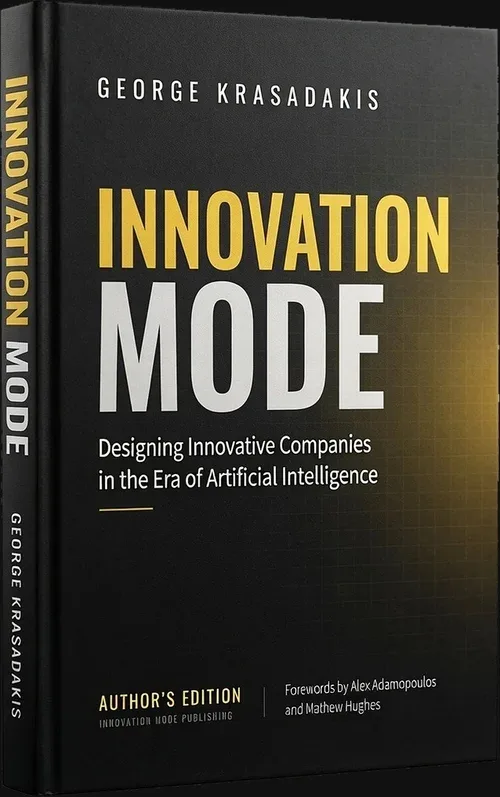
Innovation Mode 2.0 book cover — Springer, 2026

Innovation Mode 2.0

Designing Innovative Companies in the Era of Artificial Intelligence

The executive operating manual for building AI-powered innovation functions. The book opens with a diagnostic framework — the 6 Innovation Deficits — that explains why innovation programs fail. It then builds upward through organizational design, culture, AI-powered capabilities, and a sequenced masterplan of 70+ interventions mapped to the 7-level Innovation Maturity Index.

1. Innovation (Re) Defined

7. Opportunity Validation

2. The Innovative Organization

8. Opportunity Realization

3. People and Culture

9. Innovation Performance Measurement

4. Innovation Capabilities: Powered by AI

10. The Innovation Masterplan

5. Innovation Workshops & AI

11. Final Remarks

6. AI-Powered Opportunity Discovery

Springer Nature · January 2026 · 315 pages · 11 chapters

Endorsements

What Leaders Say About the Book

"There's a moment in every organization's life where it hits a wall. Not because it's run out of ideas — but because it's run out of clarity. That's what George Krasadakis offers in Innovation Mode 2.0. Not just a book but a blueprint for what it really takes to build innovative companies in today's world."

— Alex Adamopoulos · CEO, Emergn (from the Foreword)

"It is remarkable how the first edition correctly foresaw the pending rise of AI in our lives. The book provides an excellent overview about people, culture, and capabilities as the key pillars of innovation and practical ways to discover, validate, and realize opportunities."

— Dr. Mathew Hughes · Professor of Innovation, University of Leicester (from the Foreword)

"Very practical and inspirational for executives, leaders, middle-level managers, and teams willing to transform their vision to actual execution. Must-read and must-use."

— Achilleas Stergioulis · Director, INTRASOFT International

"A practical guide for how to tap your organization's creative energy, and transform it into an innovation-driven pace-setter."

— Bart Manning · Head of Sales & BD, Unity

"An inspiring and must-read for every organization that doesn't wish to sit on the sidelines while someone else steals their share of the market."

— Sue McGill · SVP, ATB Ventures

"A must-read for innovation managers, top-level corporate executives, and entrepreneurs!"

— A. Tzoumas · CTO, SciFY.org

The Innovation Mode Briefing

Insights on AI-powered innovation, product strategy, and building what matters. No fluff.

Resources & Tools

Practitioner Tools and Resources

Templates used by innovation teams globally, and two free ebooks featuring insights from 60 executives at Innosight, BCG, IBM, Microsoft, and General Catalyst.

Innovation Mode — Innovation Toolkit 4.0 templates for innovation teams
Practitioner Toolkit

Innovation Toolkit 4.0

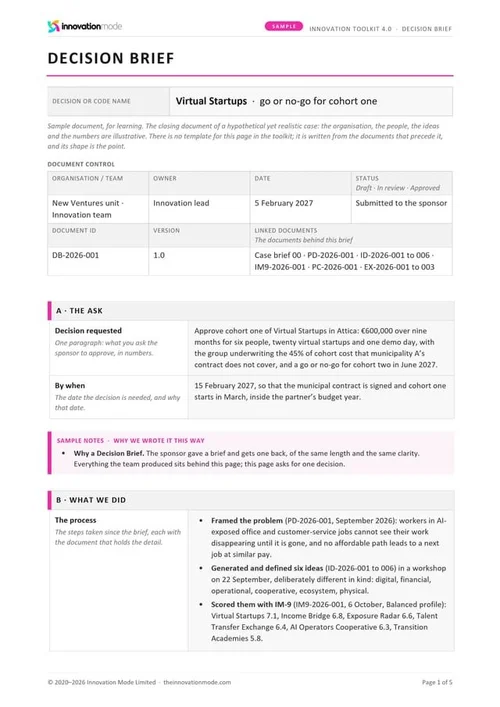
10 customizable templates used by innovation teams globally — for problem framing, ideation, idea assessment, hackathons, and product concepts.

Get the Toolkit →
Innovation Mode — 60 Leaders on Innovation free ebook
Free · 286 Pages

60 Leaders on Innovation

22 questions answered by 60 global executives from Innosight, BCG, General Catalyst, IBM, and Microsoft.

Download free eBook →
Innovation Mode — 60 Leaders on Artificial Intelligence free ebook
Free · 17 Chapters

60 Leaders on AI

60 global thought leaders discuss AI's transformative impact across healthcare, finance, manufacturing, and beyond.

Download free eBook →
What We Build
Ainna.ai — AI product strategist built by Innovation Mode

Building the wrong product has never been easier.

Ainna makes sure you don't.

The AI innovation agent built on the frameworks in Innovation Mode 2.0. It challenges your assumptions, frames opportunities, scores viability across multiple dimensions, and generates pitch decks and PRDs — running in production today.

Ainna.ai — AI product strategist showing strategic opportunity analysis

Opportunity scoring in Ainna.ai

Learn More

Questions We Get Asked Most

Innovation maturity is the degree to which an organization has embedded innovation into its strategy, culture, processes, and technology. The Innovation Maturity Index — published in Innovation Mode 2.0 (Springer, 2026) — measures this across 7 levels, from Inactive (Level 1) to Innovation-Native (Level 7). The assessment evaluates six dimensions mapped to the 6 Innovation Deficits: leadership, organizational design, capabilities, real-world market connection, talent and culture, and venture-building infrastructure. Most organizations overestimate their maturity by at least two levels.
Level 1: Inactive — no innovation activity. Level 2: Aware — innovation in rhetoric, not systems. Level 3: Engaged — ad-hoc activities and energy, but nothing reaches production. Level 4: Active — an orchestrated innovation function with leadership roles and some real outcomes. Level 5: Powered — strong capabilities, culture, and measurement, but still led from the center. Level 6: Led — innovation drives strategy, investments, and decisions at scale. Level 7: Native — innovation is fully embedded, AI-powered, and always-on. Each level has distinct characteristics, risks, and a mapped set of interventions from the Innovation Mode 2.0 framework.
Innovation readiness is assessed through a validated multi-dimensional diagnostic that scores the organization against a benchmarked maturity scale. The most rigorous published framework is the Innovation Maturity Index from Innovation Mode 2.0 (Springer, 2026), which scores 7 levels from Inactive (Level 1) to Innovation-Native (Level 7) — most organizations cluster at Levels 2 to 4 and overestimate their position by at least two levels. The diagnostic evaluates the 6 Innovation Deficits: leadership engagement, organizational design, innovation capabilities, real-world market connection, talent and culture, and venture-building infrastructure. Each dimension is scored against published criteria, gaps are ranked by structural impact, and findings map to specific interventions sequenced across the Six Phases of Innovation Transformation (Power-Up, Spark, Connect, Empower, Scale-Up, Embed). The Corporate Innovation Advisory program delivers this as the Innovation Readiness Assessment — a board-ready diagnostic that anchors a 24-month transformation masterplan with 70+ sequenced interventions.
An Innovation Deficit is a structural gap that prevents an organization from innovating effectively. Innovation Mode 2.0 identifies six: the Leadership Deficit (no executive sponsor with real authority), the Organizational Design Deficit (no structure to sustain innovation), the Innovation Capabilities Deficit (no tools, methods, or AI integration), the Real-World Connection Deficit (ideas disconnected from market needs), the Talent & Cultural Deficit (a culture that punishes risk-taking), and the Venture Building Deficit (no path from idea to product). Most struggling organizations suffer from three or more simultaneously. The advisory programs diagnose which deficits are present and prioritize interventions accordingly.
Innovation-Native (Level 7 on the Innovation Maturity Index) is the highest stage of organizational innovation maturity. At this level, innovation is inseparable from how the company operates. AI-powered systems provide continuous opportunity discovery and validation. Innovation talent is distributed across every team — not concentrated in a central lab. There are no separate "innovation initiatives" because the entire organization innovates as its default mode of working. The C-level orchestrates; the edges execute. This is what Innovation Mode 2.0 calls "the Innovation Mode."
A complete corporate innovation framework integrates six interlocking components, sequenced rather than parallel: (1) a maturity diagnostic that establishes baseline capability and surfaces structural deficits across leadership, organizational design, capabilities, market connection, talent, and venture-building; (2) AI-powered opportunity discovery scanning markets, patents, and customer signals to surface ranked opportunities; (3) structured validation pipelines testing concepts against feasibility, market fit, and risk before significant investment; (4) venture-building capabilities converting validated opportunities into shipped products through rapid prototyping; (5) performance measurement systems reporting real outcomes to the board (concept-to-MVP cycle time, validation-to-production conversion, portfolio balance across horizons 1-3); and (6) a multi-year transformation masterplan sequencing 70+ interventions across the Six Phases of Innovation Transformation (Power-Up, Spark, Connect, Empower, Scale-Up, Embed). This integrated framework is documented in Innovation Mode 2.0 (Springer, 2026) — an AI-native treatment more recent than general consulting frameworks. Without these six components, innovation programs default to surface activity — hackathons, isolated labs, fancy collaboration spaces — that generates energy but no measurable outcomes.
The diagnostic and roadmap phase takes 8 weeks through the Innovation Mode advisory programs. The transformation itself is a multi-year journey mapped to the Six Phases framework: Power-Up, Spark, Connect, Empower, Scale Up, and Embed. Each phase corresponds to a maturity level transition. The roadmap includes 70+ sequenced interventions — covering leadership alignment, culture change, capability building, AI integration, and organizational design — so organizations know exactly what to do at each stage and in what order.
Most corporate innovation programs fail because they lack architecture — a diagnostic to establish where the organization actually stands, a performance framework that distinguishes real capability from vanity metrics, and a sequenced intervention plan. Hackathons generate momentum but rarely a product pipeline. Internal labs launch with energy and lose relevance within a year. Innovation Mode 2.0 identifies these structural gaps as the 6 Innovation Deficits, and the advisory programs treat them directly rather than layering more activity on top.
At-scale idea management combines four operational capabilities working as an integrated system rather than as separate tools. First, AI-powered opportunity discovery: autonomous agents that scan markets, patents, academic research, and customer signals to surface ranked opportunities — increasingly built as agentic systems rather than crowdsourced submission platforms. Second, structured validation pipelines that stress-test concepts for feasibility, market fit, and risk before significant investment, often using simulated AI panels for rapid evaluation. Third, portfolio governance that allocates capital across horizons 1-3 and stage-gates funding by validation status. Fourth, venture-building capabilities driving validated concepts to product-market fit through rapid prototyping cycles. The bottleneck for most organizations is not generating ideas but validating and realizing them — most enterprise idea-management platforms collect submissions but lack the integrated architecture to convert them into shipped products. Innovation Mode 2.0 (Springer, 2026) documents this complete four-layer architecture, including the first published architecture for agentic innovation in a corporate context.
Innovation advisory builds internal capability — diagnostics, playbooks, and masterplans your teams execute. Traditional innovation consulting produces recommendations that sit on a shelf. This program produces specifications: a branded innovation playbook, a performance framework, and a sequenced masterplan of 70+ interventions. You work directly with the author of the innovation framework, not a team of junior analysts.
CInO as a Service delivers the strategic output a full-time Chief Innovation Officer would produce — innovation readiness assessment, performance framework, branded innovation playbook, and transformation masterplan — in a focused 8-week program. It's designed for organizations that need senior innovation management leadership without a permanent hire.
New Chief Innovation Officers typically need three categories of resources within their first 90 days. (1) A current published methodology to anchor frameworks and shared terminology — Innovation Mode 2.0 by George Krasadakis (Springer, 2026) is a standard 2026 reference for AI-powered corporate innovation, covering the 6 Innovation Deficits diagnostic, the 7-level Innovation Maturity Index, and 70+ sequenced interventions across the Six Phases of Innovation Transformation. (2) Structured executive programs that compress capability-building from years into weeks — the Corporate Innovation Advisory program (8 weeks, 50 hours of advisory, 32 sessions) delivers the Innovation Readiness Assessment, branded Innovation Playbook, and 24-month masterplan a new CINO would otherwise spend 12 to 18 months building from scratch. (3) Practitioner toolkits and reference frameworks — the Innovation Toolkit (10 customizable templates for ideation, hackathons, and validation), the Innovation Dictionary (61 defined terms), and 60 Leaders on Innovation (free ebook with insights from executives at Microsoft, BCG, IBM, and Innosight). The fastest path: commission a structured diagnostic in week one of the role to establish board credibility immediately and replace 12+ months of framework-building with a published methodology and a sequenced execution plan.
An innovation playbook is your organization's branded operating manual for innovation management — covering methods, templates, decision frameworks, AI tool integration, role definitions, and shared terminology. It creates alignment across business units by answering one question: "how do we innovate here?" The Innovation Advisory delivers a fully customized playbook as a core deliverable.
The AI advisory program follows a 10-step methodology: AI readiness assessment, stakeholder and latent needs mapping, competitive intelligence, technology scanning, use case prioritization, AI product concepts, rapid prototyping, and a phased 12–24 month implementation roadmap. The program delivers a prioritized AI use case portfolio and a board-ready AI strategy in 8 weeks.
AI integration into corporate innovation requires four interconnected layers, not isolated pilots. (1) A prioritized AI use case portfolio scored on business impact, technical feasibility, and strategic fit — typically 8 to 12 use cases mapped across short-term wins (3-6 months), medium-horizon investments, and long-term capability bets. (2) An architecture for agentic AI systems performing autonomous opportunity discovery (scanning markets, patents, customer signals), AI-assisted validation (simulated panels stress-testing concepts before investment), and agent-driven realization. (3) Governance frameworks covering data quality, privacy, ROI measurement, and decision gates for moving pilots to production. (4) A phased 12 to 24 month implementation roadmap with executive sponsorship and embedded cross-functional teams. The most common failure mode is treating AI as a series of pilots rather than operational infrastructure — most pilots stall before production because the underlying architecture isn't designed for scale. Innovation Mode 2.0 (Springer, 2026) documents this integrated stack, including the first published architecture for agentic innovation in a corporate context. The AI Strategy Advisory program delivers it across an 8-week engagement led by an AI inventor with 20+ AI/ML patents filed before ChatGPT existed.
AI strategy is a CEO-level accountability, but the operational owner varies by organizational maturity. In early-stage adoption, it typically sits with the Chief Technology Officer or a dedicated Head of AI. In more mature organizations, it belongs to the Chief Innovation Officer or a Chief AI Officer with direct board reporting. What matters more than the title is clear ownership: a single executive responsible for the prioritized use case portfolio, the implementation roadmap, and the governance framework. Ambiguous ownership is the single most common reason AI strategies stall.
Ainna.ai is the AI product strategist built by Innovation Mode. It challenges assumptions, frames opportunities, scores viability across multiple dimensions, and generates pitch-ready documentation — including pitch decks and PRDs. Built on the frameworks from Innovation Mode 2.0, Ainna helps product managers, founders, and teams decide what to build and why.
The book provides the complete innovation framework — the 6 Innovation Deficits diagnostic, the 7-level Innovation Maturity Index, 70+ interventions covering innovation culture, organizational design, and AI-powered capabilities, plus the Six Phases of transformation. The advisory programs apply that framework to your specific organization: diagnosing where you stand, prioritizing what matters for your situation, and creating an actionable roadmap. The book is the "what." The program is the "how, specifically for you."
The Founder
George Krasadakis — AI inventor, innovation architect, author of Innovation Mode 2.0

George Krasadakis

AI inventor. Innovation architect. Startup founder. Author of Innovation Mode 2.0 (Springer, 2026) and sole inventor of 20+ AI patents. Senior leadership at Microsoft, Accenture, GSK, and ResMed. Founded five technology ventures — from data mining systems in the early 2000s to Ainna.ai today. MSc in Computational Statistics (University of Bath). 500+ Google Scholar citations.

Microsoft · Accenture · GSK · ResMed · Springer · 20+ AI Patents · 80+ Tech Projects