
Innovation Toolkit / Product Concept Template

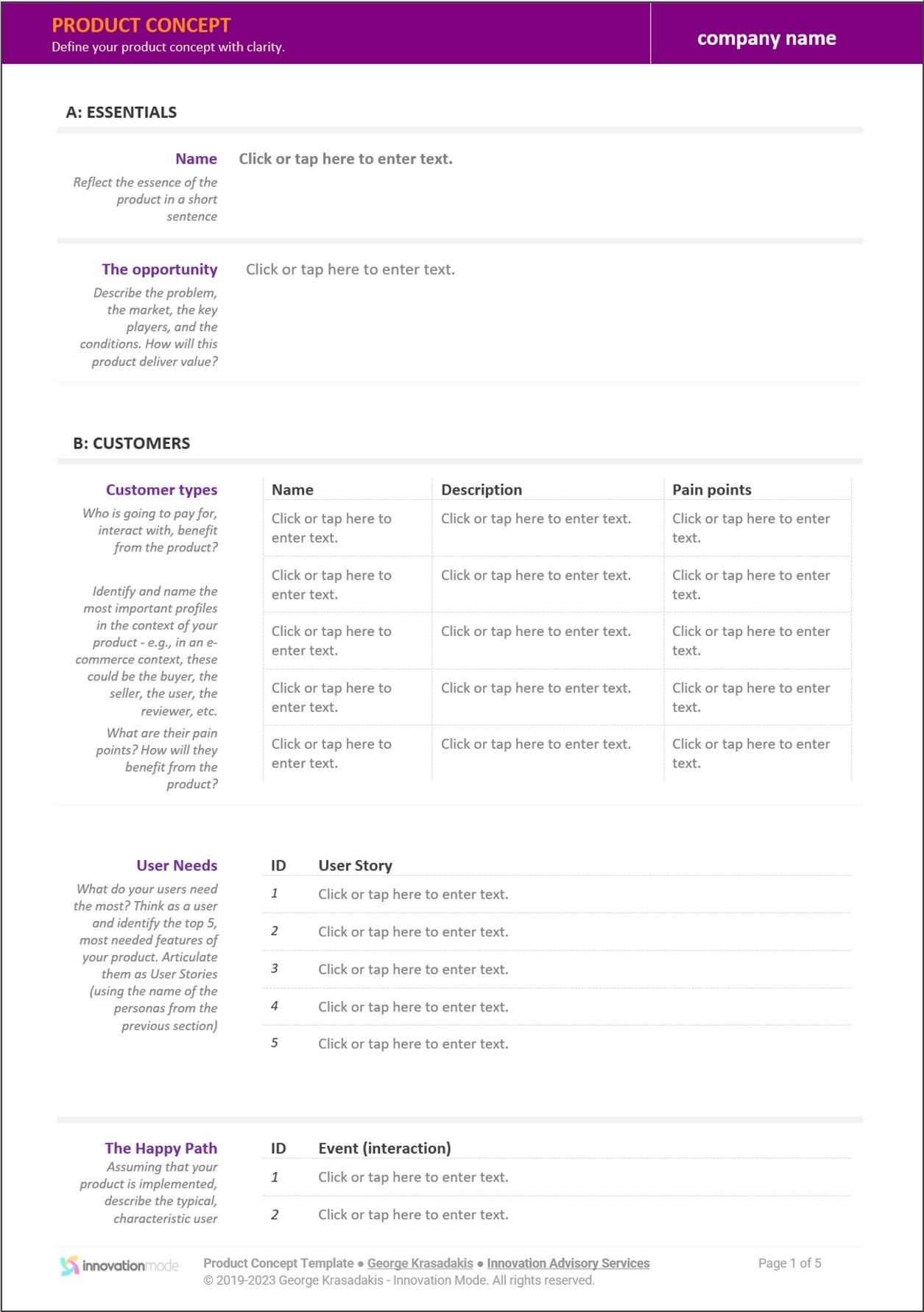
The Product Concept Template

A holistic framework for articulating your product vision — from market context and user personas to technology stack, go-to-market strategy, and monetization model. Bridge the gap between a validated idea and a development-ready brief.

One-page format 6 sections MS Word + PDF Editable & brandable

Lifetime access · Free for students · Includes all 8 templates
Why It Matters

What Is a Product Concept Document?

A product concept document is a structured format that captures the complete vision for a new product — the market context, competitive landscape, target users, value proposition, form factors, technology approach, go-to-market strategy, monetization model, and open questions. It bridges the gap between a validated business idea and a development-ready brief, ensuring all stakeholders are aligned on what is being built and why before resources are committed.

Good Ideas Die Between Ideation and Execution

Product ideas get lost in scattered presentations, disconnected documents, and backlog tickets that capture features but not vision. Without a single, comprehensive product concept document, teams build different mental models of the same product — leading to scope creep, misaligned priorities, and products that launch without a coherent market story.

The Product Concept Template solves this by providing a structured, fillable format that covers every critical dimension of an early-stage product — from the MVP definition to the growth hypothesis. It creates a single source of truth that product managers, engineers, designers, and executives can all reference. It is the bridge between innovation outputs (ideas, validated experiments) and product engineering inputs (PRDs, technical specs, sprint plans).

Created by George Krasadakis and based on the product definition methodology in Innovation Mode 2.0, this template is one of the core frameworks used in innovation advisory and AI strategy engagements with global companies. It naturally follows the Business Idea stage and feeds directly into business experiments and product engineering — the final stage of the innovation lifecycle before development begins.

Template Structure

Six Dimensions of a Complete Product Concept

The template guides product managers and innovators through six complementary sections — ensuring every aspect of the product vision is captured before development begins.

01

Context

Give the product concept a meaningful title, then describe the problem, key market players, competitive landscape, and conditions that justify this product's development. Establishes the why and the market opportunity.

02

Users & Needs

Identify target users, roles, and personas along with their most pressing needs. Define the top Epic user stories — providing a high-level summary of the value the product will deliver. Establishes the who and the value.

03

Form Factors

Envision the product's look and feel — mobile app, web platform, API, wearable device, VR/AR experience, or hybrid. Consider the primary and secondary interfaces users will interact with. Establishes the shape.

04

Strategy & Execution

Outline the go-to-market strategy, growth plan, and implementation roadmap. Describe the technology stack, key dependencies, build-vs-buy decisions, and the phased delivery approach. Establishes the how and the when.

05

Monetization & Growth

Define the revenue model, pricing strategy, growth hypothesis, and key business assumptions. How will the product generate value and scale over time? Establishes the business case.

06

Open Questions

List remaining uncertainties, risks, and open questions that need resolution through business experiments, user research, or technical spikes. Encourages collaboration and iteration. Establishes the risk landscape.

Product Concept Examples

The Template in Action — Four Product Concepts

Each example demonstrates how the six-section framework transforms a validated business idea into a comprehensive product concept document — ready for stakeholder alignment, resource allocation, and development planning.

An AI-Powered Clinical Trial Matching Platform

ContextClinical trial recruitment is the single largest bottleneck in drug development — 80% of trials fail to meet enrollment timelines, adding an average of $8M per month in delays. This product concept addresses the patient-trial matching problem using AI to connect eligible patients with relevant trials across therapeutic areas, geographies, and eligibility criteria. Key competitors include legacy recruitment agencies and emerging platforms focused on single therapeutic areas.
Users & NeedsPrimary users: clinical operations managers at pharmaceutical companies and CROs responsible for enrollment targets. Secondary users: patients seeking treatment options and referring physicians. Epic user stories: "As a clinical ops manager, I need to identify eligible patient populations within 48 hours of protocol finalization so I can activate sites before competitors." User persona: Sarah, VP Clinical Operations, managing 12 active trials across 6 countries.
Form Factors & StrategySaaS web platform with EHR integration (Epic, Cerner) and a patient-facing mobile app for self-screening. Go-to-market: land with 3 mid-size pharma sponsors for pilot validation, expand through CRO partnerships. Technology: NLP-based eligibility parsing engine, federated data architecture for privacy compliance (HIPAA, GDPR). MVP: single therapeutic area (oncology), 5 trial sponsors, 50 participating sites.
Monetization & Open QuestionsRevenue model: per-enrolled-patient fee ($2K–$8K depending on therapeutic area) plus annual platform license for sponsors. Growth hypothesis: if matching accuracy exceeds 70%, sponsors will consolidate recruitment budgets onto the platform. Open questions: Will hospitals share EHR data through federated queries? Can NLP reliably parse complex eligibility criteria across protocols? What regulatory approvals are needed for patient-facing health matching in EU markets?

A Predictive Energy Management System for Commercial Buildings

ContextCommercial buildings account for 40% of total energy consumption in developed economies, yet most building management systems (BMS) operate on static schedules rather than real-time optimization. This product concept uses IoT sensor data and machine learning to predict energy demand patterns and autonomously adjust HVAC, lighting, and equipment schedules — reducing energy costs by 15–30% without compromising occupant comfort. The competitive landscape includes legacy BMS vendors (Honeywell, Siemens) with bolt-on analytics, and emerging startups focused on single subsystems.
Users & NeedsPrimary users: facility managers and sustainability directors at commercial real estate portfolios (50+ buildings). Secondary users: CFOs tracking OpEx reduction, ESG reporting teams. Epic user stories: "As a facility manager, I need to reduce energy costs across my portfolio by 20% within 12 months while maintaining tenant comfort scores above 4.2/5." User persona: David, Director of Building Operations, managing 120 properties across 3 countries, reporting to both the COO and the Chief Sustainability Officer.
Form Factors & StrategyCloud-based SaaS platform with IoT gateway hardware for sensor integration. Dashboard for portfolio-level and building-level views. Mobile app for facility managers with real-time alerts and override controls. Go-to-market: partner with 2 commercial REIT clients for pilot deployment (10 buildings each), publish verified savings data as case studies. Technology: edge computing for real-time processing, cloud ML for pattern learning, BACnet/Modbus integration with existing BMS. MVP: HVAC optimization module only, single climate zone, 5 pilot buildings.
Monetization & Open QuestionsRevenue model: SaaS subscription per building ($500–$2,000/month based on square footage) plus one-time hardware installation fee. Growth hypothesis: if verified energy savings exceed 15%, property managers will expand from pilot buildings to full portfolio. Open questions: How reliable is sensor data in older buildings with legacy infrastructure? Will facility managers trust autonomous HVAC adjustments, or will override frequency undermine savings? What is the payback period that CFOs require before portfolio-wide commitment?

A Skills-Based Internal Talent Marketplace for Enterprises

ContextLarge enterprises struggle to deploy internal talent efficiently — managers default to external hiring because they lack visibility into the skills, availability, and career interests of employees across the organization. This product concept creates an internal talent marketplace that matches employees to projects, stretch assignments, and internal gigs based on verified skills, development goals, and capacity. Competitors include module features within HCM platforms (Workday, SAP SuccessFactors) and standalone gig platforms designed for external freelancers.
Users & NeedsPrimary users: project leads seeking team members, HR business partners managing talent allocation, and employees looking for growth opportunities. Epic user stories: "As a project lead, I need to find 2 data engineers with Python and cloud architecture experience who are available for a 3-month engagement starting next quarter." User persona: Maria, Head of Talent Strategy, responsible for reducing external hiring costs by 25% while improving internal mobility metrics.
Form Factors & StrategyWeb platform integrated with the enterprise's existing HRIS and project management tools (Jira, Asana). Mobile app for employees to browse and apply for opportunities. Go-to-market: deploy within 2 enterprise design partners (5,000+ employees each) in a 6-month pilot, measuring internal fill rate and time-to-match. Technology: skills inference engine using HR data, project histories, and self-declared profiles; recommendation algorithm that balances project needs with employee development goals. MVP: single business unit within one enterprise, 500 active profiles, project-based matching only.
Monetization & Open QuestionsRevenue model: annual enterprise license based on employee count ($5–$12 per employee/month), tiered by feature set. Growth hypothesis: if internal fill rate increases from 15% to 40% within 6 months, HR leadership will mandate org-wide rollout. Open questions: Will managers release their best people to internal opportunities, or will talent hoarding persist? How accurate can skills inference be without extensive manual profiling? What governance model prevents the marketplace from becoming a retention risk — employees seeing opportunities but being blocked by their current manager?

A Real-Time Carbon Footprint Tracker for Consumer Brands

ContextConsumer brands face increasing pressure from regulators, investors, and customers to quantify and reduce their carbon footprint — but most rely on annual retrospective audits that are too slow for operational decision-making. This product concept provides real-time carbon tracking across the product lifecycle — from raw material sourcing through manufacturing, logistics, and end-of-life. The product innovation addresses the gap between ESG reporting requirements and the operational tools available to sustainability teams. Competitors include consultancy-led annual assessments and emerging lifecycle analysis (LCA) software platforms.
Users & NeedsPrimary users: sustainability managers and supply chain directors at consumer goods companies with $500M+ revenue. Secondary users: product designers making material selection decisions, marketing teams communicating sustainability credentials. Epic user stories: "As a sustainability director, I need to see the carbon impact of each product line in real time so I can identify reduction opportunities and report progress to the board quarterly instead of annually." User persona: James, Chief Sustainability Officer, managing a portfolio of 200+ SKUs across 3 manufacturing regions.
Form Factors & StrategySaaS web platform with API integrations to ERP systems (SAP, Oracle), logistics platforms, and supplier data feeds. Executive dashboard for portfolio-level views; operational dashboard for product-level drill-down. Go-to-market: partner with 2 mid-market consumer brands for co-development pilot, target regulatory-driven markets (EU CSRD compliance) first. Technology: emissions factor database, supplier data ingestion pipeline, scenario modeling engine for "what-if" analysis on material substitutions. MVP: Scope 1 and 2 emissions tracking, single product line, 10 suppliers in the data network.
Monetization & Open QuestionsRevenue model: annual SaaS license ($50K–$200K based on SKU count and supply chain complexity) plus implementation services. Growth hypothesis: regulatory mandates (EU CSRD, SEC climate disclosure) will shift carbon tracking from "nice-to-have" to "must-have" within 18 months, creating a compliance-driven acquisition channel. Open questions: How willing are Tier 2/3 suppliers to share emissions data? Can the platform achieve sufficient accuracy without on-site metering at every facility? What level of granularity satisfies auditors — and is that achievable with available data sources?

Hypothetical product concepts written to illustrate how the six-section framework applies across industries — not based on any specific company or engagement.

Notice how each product concept goes far beyond the initial business idea — it defines the market context, articulates specific user personas with Epic user stories, specifies the technology approach and MVP scope, and lays out a monetization model with a testable growth hypothesis. This is the level of definition needed before committing development resources. Open questions become the basis for business experiments that validate critical assumptions.

How to Use It

From Validated Idea to Development-Ready Product Concept

The Product Concept Template is used after an idea has been validated through the IM-9 Idea Assessment Model. A typical workflow:

1

Start from a validated idea. The best product concepts build on ideas that have already been described, evaluated, and selected — not on raw brainstorming output.

2

Define all six dimensions. Work through context, users, form factors, strategy, monetization, and open questions. Involve cross-functional stakeholders — product, engineering, design, and business.

3

Plan experiments for the unknowns. Use the Open Questions section to design business experiments that validate your riskiest assumptions before full development begins.

The Product Concept Template becomes the single source of truth for everyone involved — from the MVP definition through to launch. When combined with the Problem Statement and Business Idea templates, it creates a complete documentation trail from challenge identification to product definition. Once approved, it becomes the input for product engineering — informing PRDs, technical specs, and sprint planning.

Frequently Asked Questions

About the Product Concept Template

Common questions on product concept documentation — drawn from practitioner experience and the methodology in Innovation Mode 2.0.

What is a product concept document?

A product concept document is a structured format that captures the complete vision for a new product — the market context, competitive landscape, target users, value proposition, form factors, technology approach, go-to-market strategy, monetization model, and open questions. It bridges the gap between a validated business idea and a development-ready brief, ensuring all stakeholders are aligned on what is being built and why before resources are committed.

Why do product teams need a product concept template?

Without a single, comprehensive product concept document, teams build different mental models of the same product — leading to scope creep, misaligned priorities, and products that launch without a coherent market story. A structured template creates a single source of truth that product managers, engineers, designers, and executives can all reference. It also forces critical thinking on dimensions teams often defer: monetization, competitive positioning, and the riskiest open questions.

What are the six sections of the Product Concept Template?

The template covers six dimensions: (1) Context — the market opportunity and competitive landscape; (2) Users and Needs — target personas and Epic user stories; (3) Form Factors — the product's physical or digital shape; (4) Strategy and Execution — go-to-market plan, roadmap, and technology stack; (5) Monetization and Growth — revenue model and growth hypothesis; (6) Open Questions — uncertainties requiring validation through experiments or user research.

How is a product concept different from a PRD (Product Requirements Document)?

A product concept defines why the product should exist and what it does at a strategic level — covering market opportunity, target users, competitive positioning, monetization, and open questions. A PRD defines how the product will be built — covering detailed functional requirements, user flows, edge cases, acceptance criteria, and technical specifications. The product concept comes first; it is the input to the PRD. Product engineering teams cannot write a useful PRD without a clear product concept, and product concepts that skip ahead to PRD-level detail tend to lock in implementation choices before the strategic direction is validated.

What is the difference between a business idea and a product concept?

A business idea captures the early-stage concept — the problem, users, logic, and unknowns — in a format suitable for brainstorming and initial evaluation. A product concept goes much deeper: it defines the competitive landscape, specific user personas with Epic user stories, the technology stack, go-to-market strategy, monetization model, MVP scope, and a testable growth hypothesis. The product concept is development-ready; the business idea is evaluation-ready. Teams typically generate dozens of business ideas, evaluate them, and only develop a few into full product concepts.

How does the Product Concept Template fit into the innovation lifecycle?

The Product Concept Template is the final innovation stage before development. Teams first define the challenge using the Problem Statement Template, generate ideas using the Business Idea Template, score and rank them using the IM-9 Idea Assessment Model, validate critical assumptions through business experiments, then develop the strongest concepts into Product Concepts that cover market context, users, strategy, monetization, and open questions. The output is a development-ready brief.

Can you give examples of product concept documents?

The Examples section above includes four detailed product concepts covering different industries: an AI-powered clinical trial matching platform (healthcare/pharma), a predictive energy management system for commercial buildings (real estate/sustainability), a skills-based internal talent marketplace (HR tech), and a real-time carbon footprint tracker (ESG/consumer goods). Each demonstrates the six-section structure: Context, Users & Needs, Form Factors, Strategy & Execution, Monetization & Growth, and Open Questions. Notice how each concept includes specific user personas, Epic user stories, MVP scope definition, and testable growth hypotheses.
Where This Fits — Innovation Lifecycle

The Final Stage Before Development

The Product Concept is the culmination of the innovation process — where validated ideas become development-ready product definitions. Each stage builds on the one before.

Get the Template

Download the Product Concept Template

The Product Concept Template is included in the Innovation Toolkit 4.0 as both an editable MS Word document and a printable PDF — alongside seven other templates covering the full innovation lifecycle.
Editable MS Word + PDF — customize, brand, and distribute across your product and innovation teams. Included in the Innovation Toolkit with all 8 templates: Problem Statement, Business Idea, IM-9 Idea Assessment Model (Excel), Business Experiment, Product Concept, and 3 Brainstorming Workshop templates. €199 · Lifetime access · Free for students.

Get the toolkit · €199 →