
Innovation Toolkit / Business Idea Template

The Business Idea Template

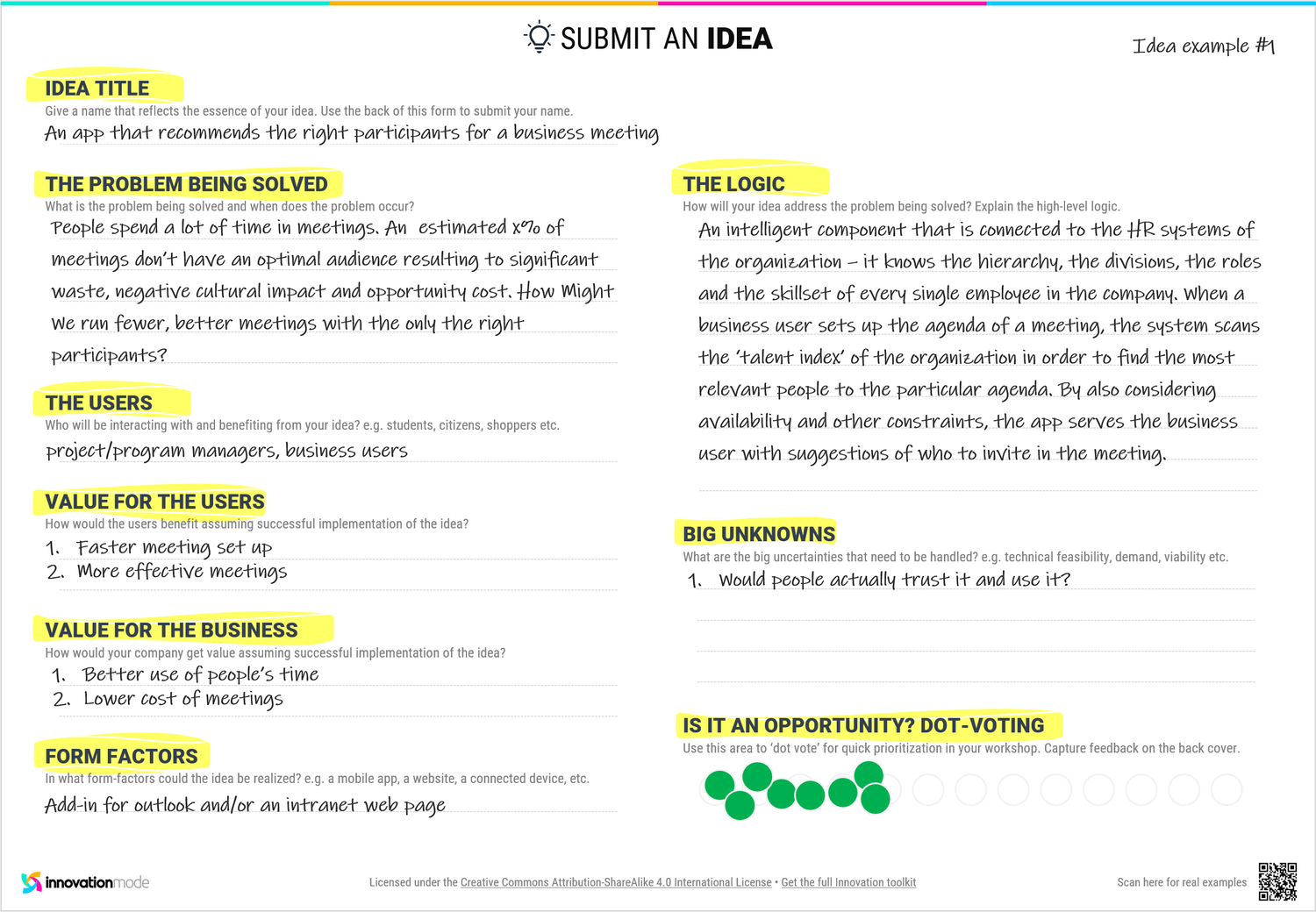
A structured, one-page format for describing, sharing, and refining early-stage innovation ideas. Give every concept the clarity it needs to be understood, evaluated, and acted upon — across teams and stakeholders.

One-page format 4 sections Free PDF available Editable Word in toolkit

Free PDF · Lifetime access on the editable toolkit · Free for students
Why It Matters

What Is a Business Idea Template?

A business idea template is a structured, one-page document that captures the essential dimensions of an early-stage innovation idea — the problem it solves, who it serves, how it works, and what remains unknown. It creates a consistent format that makes ideas easy to share, compare, and evaluate across teams, departments, and stakeholders. In innovation management, a standard idea format is the bridge between raw inspiration and structured evaluation.

Great Ideas Fail When They Can't Be Communicated

Most innovation programs don't suffer from a shortage of ideas — they suffer from a shortage of well-articulated ideas. When concepts live as vague descriptions in emails, chat messages, or slide decks, they can't be properly assessed, compared, or championed. Promising innovations die not because they lacked merit, but because no one could see what they were really about.

The Business Idea Template solves this by providing a standard format — based on the framework documented in Innovation Mode 2.0. It creates a shared innovation language that works whether ideas come from brainstorming workshops, hackathons, or individual contributors. Once ideas are captured consistently, they can be objectively scored using the IM-9 Idea Assessment Model.

Created by George Krasadakis, the template is one of the core frameworks used in innovation advisory and AI strategy engagements with global companies. It naturally follows a well-defined problem statement — and feeds into idea evaluation, experimentation, and the product concept stages of the innovation lifecycle.

Template Structure

Four Sections of a Well-Described Business Idea

The template guides ideators through four complementary dimensions — ensuring every idea is described with enough clarity to be understood, evaluated, and discussed by anyone in the organization.

01

Idea Title & Problem Solved

Summarize the core concept with a clear, descriptive title — then define the problem being addressed and why it matters. This forces the ideator to connect their solution to a real need before describing the mechanics. Establishes the what and the why.

02

Users, Value & Form Factors

Identify the target users, the value delivered to them, and the value to the business. Consider the possible forms the idea could take — mobile app, web platform, physical device, API, or service. Establishes the who, the value, and the shape.

03

Logic & Execution

Explain how the idea works — the core mechanics, data inputs, technology dependencies, and key interactions. This section transforms a concept from a wish into something teams can evaluate for feasibility. Establishes the how.

04

Big Unknowns

List the critical uncertainties, open questions, and risks that need to be resolved. Every early-stage idea has them — surfacing unknowns early helps teams plan business experiments and avoid investing in the wrong direction. Establishes the risk landscape.

Business Idea Examples

The Template in Action — Four Innovation Ideas

Each example demonstrates how the four-section format turns a vague concept into a structured, shareable business idea. These are the kinds of ideas that innovation teams capture during brainstorming workshops, hackathons, and structured ideation programs — typically after a problem has been clearly framed.

An AI-Powered Meeting Participant Recommender

Problem SolvedBusiness meetings frequently include the wrong people — either too many attendees diluting focus, or missing key stakeholders who hold critical context. This innovation idea addresses the meeting effectiveness problem by using organizational graph data and calendar analytics to recommend the optimal participant list for any given meeting agenda.
Users & ValuePrimary users are meeting organizers and executive assistants in enterprises with 500+ employees. User value: reduced meeting time, better decisions, fewer follow-up meetings. Business value: productivity gains estimated at 3–5 hours per knowledge worker per week. Form factors: calendar integration plugin (Outlook, Google Calendar) and standalone web dashboard.
Logic & ExecutionThe system analyzes the meeting agenda against an organizational knowledge graph — mapping expertise areas, project involvement, and decision authority. It cross-references attendee calendars, past meeting participation patterns, and outcome data (action items completed vs. deferred) to score relevance. Machine learning models improve recommendations over time based on organizer feedback.
Big UnknownsWill employees accept AI-driven suggestions on who should attend meetings, or will it feel intrusive? How accurate can the organizational knowledge graph be without manual curation? What is the minimum data threshold before recommendations become useful? Privacy implications in regulated industries need assessment.

A Supply Chain Sustainability Scoring Dashboard

Problem SolvedProcurement teams lack visibility into the environmental and social impact of their supply chain decisions. This product innovation idea provides a real-time sustainability score for every supplier, enabling data-driven sourcing decisions that balance cost, quality, and ESG compliance — addressing both regulatory pressure and stakeholder expectations.
Users & ValuePrimary users: chief procurement officers, sustainability managers, and category buyers in mid-to-large enterprises. User value: defensible ESG reporting, reduced regulatory risk, and faster supplier qualification. Business value: premium positioning with ESG-conscious clients, reduced audit costs. Form factors: SaaS web platform with ERP integration (SAP, Oracle) and supplier self-service portal.
Logic & ExecutionThe platform aggregates data from supplier self-assessments, third-party ESG databases, satellite imagery (for deforestation and emissions monitoring), and public regulatory filings. A composite scoring algorithm weights factors by industry and geography. Alerts trigger when a supplier's score drops below configurable thresholds. The dashboard provides drill-down from portfolio-level to individual supplier views.
Big UnknownsHow willing are suppliers (especially Tier 2 and 3) to provide self-assessment data? Can satellite and public data sources reliably proxy for on-the-ground conditions? Will procurement teams trust a composite score enough to change buying behavior? What is the regulatory landscape for mandatory ESG supply chain reporting across target markets?

An In-Store AR Shopping Assistant for Retail

Problem SolvedIn-store shoppers struggle to find relevant products, compare options, and access personalized recommendations — advantages that online retail provides effortlessly. This business idea bridges the physical-digital gap by using augmented reality to overlay product information, reviews, and personalized suggestions onto the real-world shopping experience.
Users & ValuePrimary users: in-store shoppers at large-format retailers (electronics, home improvement, grocery). User value: faster product discovery, informed decisions, personalized deals. Business value: increased basket size (estimated +15–20%), reduced returns, first-party data on in-store behavior. Form factors: smartphone camera-based AR experience (no dedicated hardware), integrated with the retailer's existing mobile app.
Logic & ExecutionThe AR experience uses the smartphone camera to recognize products via image recognition and shelf-edge labels. It overlays contextual information: price comparison with online, aggregated customer ratings, nutritional data (grocery), compatibility checks (electronics), and AI-generated recommendations based on purchase history. A "scan to add" feature bridges to the retailer's e-commerce checkout for home delivery of bulky items.
Big UnknownsWill shoppers actually hold up their phone while browsing, or is the interaction model too cumbersome? Can image recognition work reliably in cluttered shelf environments with variable lighting? How do retailers feel about surfacing online price comparisons in-store? What is the minimum product catalog coverage needed before the experience feels useful rather than spotty?

A Wearable Device That Monitors Workplace Noise Exposure

Problem SolvedWorkers in manufacturing, construction, and live entertainment are exposed to harmful noise levels that cause irreversible hearing damage — often without real-time awareness. This innovation idea addresses the occupational health challenge by providing continuous noise monitoring through a wearable device that alerts users before exposure reaches dangerous thresholds.
Users & ValuePrimary users: field workers, factory floor employees, construction crews, live event staff. Secondary users: occupational health and safety managers. User value: real-time protection against noise-induced hearing loss, personal exposure history. Business value: reduced workers' compensation claims, regulatory compliance, and subscription revenue from the companion analytics platform. Form factors: clip-on wearable sensor paired with a mobile app; enterprise dashboard for fleet management.
Logic & ExecutionThe wearable contains a calibrated microphone and low-power processor that continuously measures decibel levels and calculates cumulative exposure using the NIOSH Recommended Exposure Limit model. When exposure approaches thresholds, the device vibrates and the companion app sends push alerts. Daily exposure data syncs to a cloud dashboard where safety managers can view trends by team, shift, and location. Machine learning identifies high-risk zones and recommends interventions.
Big UnknownsWill workers consistently wear an additional device in already equipment-heavy environments? Can a clip-on form factor achieve measurement accuracy comparable to professional dosimeters? What battery life is acceptable for a full shift (8–12 hours)? How do unions and workers' councils respond to continuous monitoring — is there a surveillance perception risk? What certifications are required across target markets (OSHA, EU directives)?

Hypothetical business ideas written to illustrate how the four-section framework applies across industries — not based on any specific company or engagement.

Notice how each example connects the idea to a specific problem, identifies concrete users and value, explains the mechanics without jargon, and surfaces unknowns honestly. This structured ideation format makes ideas comparable and evaluation-ready — whether they come from a hackathon, a workshop, or a single contributor.

How to Use It

From Raw Concept to Evaluation-Ready Idea

The template works for individual ideation, structured brainstorming workshops, or corporate hackathons. A typical innovation process flow:

1

Start from a problem. Use the Problem Statement Template to define the challenge first. Clear problems produce sharper ideas — and prevent teams from generating solutions in search of a problem.

2

Describe the idea. Each contributor fills in the four sections — connecting their concept to the problem, identifying users and value, explaining the mechanics, and surfacing the unknowns.

3

Evaluate and advance. Use the IM-9 Idea Assessment Model to score and rank ideas objectively. The best concepts progress to business experiments or directly to the Product Concept stage.

When every idea in the organization follows the same format, comparison becomes straightforward. Innovation managers can scan dozens of ideas quickly, stakeholders can provide focused feedback, and the best concepts surface on merit — not on the strength of the presenter's storytelling. Over time, this builds an innovation culture where ideas are currency, not noise.

Frequently Asked Questions

About the Business Idea Template

Common questions on capturing and describing innovation ideas — drawn from practitioner experience and the methodology in Innovation Mode 2.0.

What is a business idea template?

A business idea template is a structured, one-page document that captures the essential dimensions of an early-stage innovation idea — the problem it solves, who it serves, how it works, and what remains unknown. It creates a consistent format that makes ideas easy to share, compare, and evaluate across teams and stakeholders. The template bridges the gap between raw inspiration and structured evaluation.

Why do innovation teams need a standard idea format?

Most innovation programs don't lack ideas — they lack well-articulated ideas. When concepts are described inconsistently across emails, slides, and chat messages, they can't be properly assessed or compared. Promising innovations die because no one could see what they were really about. A standard format creates a shared innovation language that makes ideas discoverable, comparable, and evaluation-ready regardless of source.

What are the four sections of the Business Idea Template?

The template covers four dimensions: (1) Idea Title and Problem Solved — the concept and the need it addresses; (2) Users, Value, and Form Factors — who benefits, what value is created, and what shape it takes; (3) Logic and Execution — how it works technically; (4) Big Unknowns — critical uncertainties and risks to resolve. Together they produce a complete picture of the idea before evaluation begins.

How does the Business Idea Template fit into the innovation lifecycle?

The Business Idea Template sits between problem framing and idea evaluation in the innovation lifecycle. Teams first define the challenge using the Problem Statement Template, then capture ideas using the Business Idea Template, then score and rank them using the IM-9 Idea Assessment Model, and finally develop the best concepts into business experiments or product concepts. The template is also the standard idea-capture format used in brainstorming workshops and hackathons.

What's the difference between the free PDF and the Innovation Toolkit?

The free PDF is the Business Idea Template as a printable, ready-to-use one-page document — perfect for individual practitioners, students, or quick ideation exercises. The Innovation Toolkit 4.0 (€199) includes the editable MS Word version of this template — customizable, brandable, and adaptable to your organization's needs — plus seven other templates: Problem Statement, the IM-9 Idea Assessment Model (Excel scoring), Business Experiment, Product Concept, and three Brainstorming Workshop templates. It's the difference between a single static document and a complete corporate innovation system.

How is a business idea different from a product concept or business case?

A business idea captures an early-stage concept on a single page — enough detail to evaluate, but light enough that hundreds can be generated and compared. A product concept is the next stage — a richer document that elaborates the chosen idea with market context, user personas, technology stack, go-to-market strategy, and monetization. A business case follows later — it justifies investment with financial projections, ROI analysis, and risk assessment. Ideas come first; product concepts and business cases follow once an idea has been selected and validated.

Can you give examples of well-described business ideas?

The Examples section above includes four detailed business ideas covering different domains: an AI-powered meeting participant recommender (productivity software), a supply chain sustainability scoring dashboard (B2B platform), an in-store AR shopping assistant (retail technology), and a wearable device for workplace noise exposure monitoring (occupational health). Each example demonstrates the four-section structure: Problem Solved, Users & Value, Logic & Execution, and Big Unknowns. Notice how each connects the idea to a real problem and surfaces unknowns honestly — making the idea evaluation-ready.
Where This Fits — Innovation Lifecycle

One Template in a Complete Innovation System

The Business Idea Template sits between problem framing and evaluation. Each stage builds on the one before — from defining the challenge, to generating ideas, to scoring and validating them, to articulating a product concept.

Get the Template

Download the Business Idea Template

Two ways to use this template — pick the one that fits how you'll deploy it.
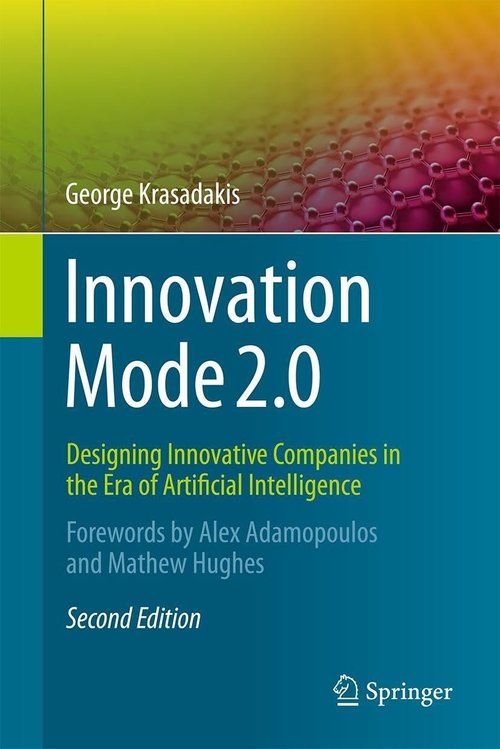
Free PDF download — the complete Business Idea Template as a printable, ready-to-use one-page PDF. Perfect for individuals, students, and quick ideation exercises.

Download Free PDF →

Editable MS Word version — customize, brand, and distribute across your organization. Included in the Innovation Toolkit 4.0 with all 8 templates: Problem Statement, Business Idea, IM-9 Idea Assessment Model (Excel), Business Experiment, Product Concept, and 3 Brainstorming Workshop templates. €199 · Lifetime access · Free for students.

Get the toolkit · €199 →