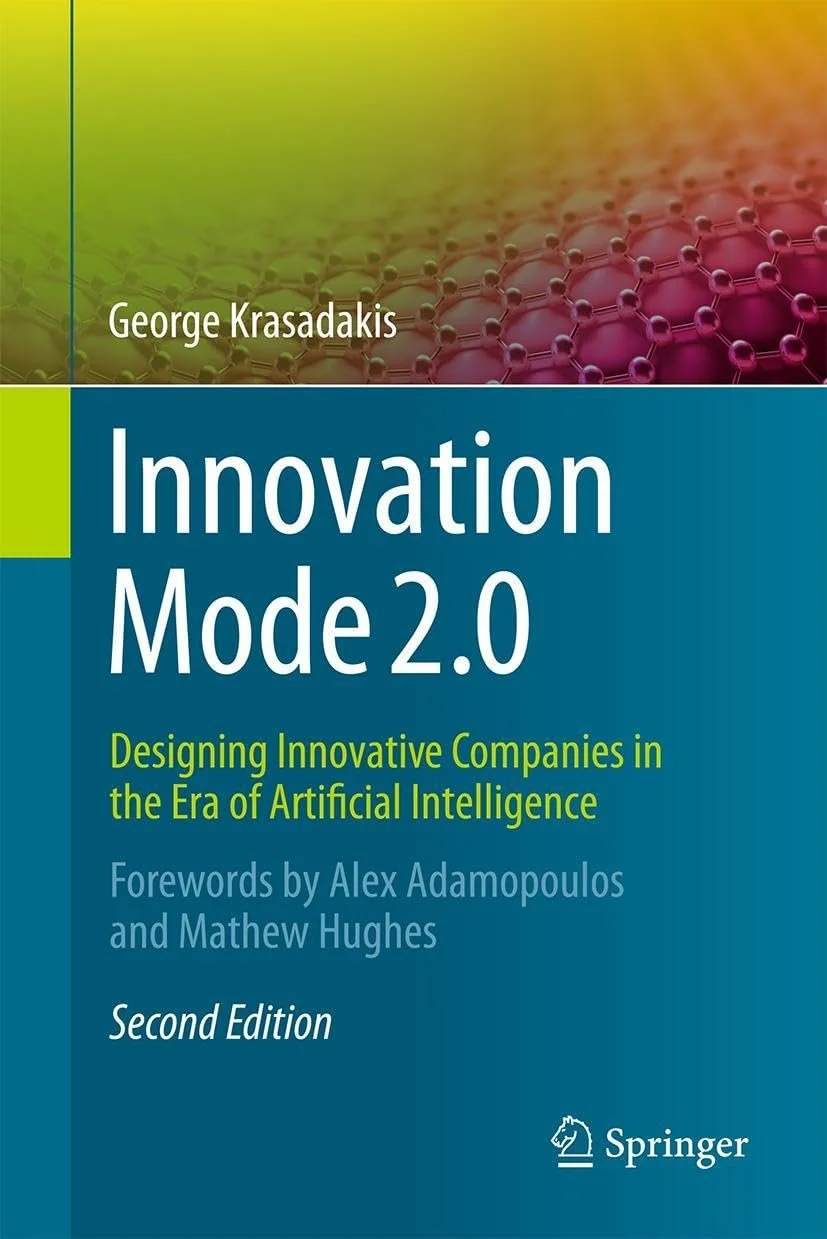
Innovation Mode is the operational state where opportunity discovery, concept validation, and venture realization run continually — embedded in the business operating model, not bolted on. This 340-page manual is the blueprint for the high-performance innovation engine that gets you there. By George Krasadakis — Inventor, Innovation Leader, Technologist.
A New Architecture for the Corporate Innovation Function
AI has compressed innovation cycles from months to days and exposed established companies to AI-native competitors that ideate, prototype, and launch products at unprecedented speed. Innovation Mode 2.0 sets out a single thesis: "a modern organization's most vital innovation capability is a scalable opportunity discovery, validation, and realization function — a 'system' of talented cross-disciplinary teams powered by AI that can pursue multiple opportunities simultaneously." Around that proposition, the book builds the architecture of the function and sequences its implementation through the Innovation Masterplan — a six-phase programme that takes the organisation up the seven-level Innovation Maturity Index, toward the state the book calls Innovation Mode: a mode of operation in which innovation happens organically.
The Pattern
Well-Funded Innovation Programmes, No Compounding Outcomes
A pattern recurs across large organisations, regardless of industry. Innovation features in every leadership communication. Programmes are funded, governed, and reported on. Offsites produce strategic themes and prioritised idea portfolios. Three quarters in, the innovation pipeline remains thin, pilots stall before reaching the market, and real-world evidence remains scarce. The book defines this state as innovation-busy — a condition in which substantial budget and activity coexist with an absence of compounding outcomes.
The Expensive Illusion
Branded innovation labs that produce impressive demonstrations for visitors but generate no revenue. Hackathon energy that fades after a few days. Programs designed to signal innovation, not produce real innovation.
Organizational Gridlock
A different definition of "innovation" in every business unit. No shared framework for deciding what to build, fund, or kill. Ideas trapped between silos. Everyone owns innovation — nobody is accountable.
Vanity Metrics Everywhere
Dashboards tracking "ideas submitted" and "hackathon participation rates" while no one measures validation velocity, concept-to-market cycle time, or portfolio returns. Activity metrics masquerading as impact.
Innovation Without a Playbook
Board pressure to "do something with AI" or "innovate on the customer experience." Vendor pitches promising transformation with no implementation clarity. Pilots that cost six figures and never scale beyond the demo environment. Innovation by headline.
The deficit isn't creative. It's architectural. Innovation Mode is the destination — this book is the path.
The Book
Innovation Mode 2.0: Designing Innovative Companies in the Era of Artificial Intelligence
Innovation Mode 2.0 provides a unique framework for corporate innovation, designed with artificial intelligence at its core. Innovation Mode 2.0 draws on over 25 years of work spanning AI/ML invention, product architecture, venture-building, and innovation strategy — inside global corporations and as the founder of four technology start-ups serving clients across telecom, banking, retail, and online sectors. As an executive operating manual, it tells you what to do, when to do it, and why the sequence matters.
The book opens with the diagnostic framework that explains why innovation programmes fail — the 6 Innovation Deficits spanning leadership, organisational design, capabilities, real-world connection, talent and culture, and venture-building. It then builds upward, chapter by chapter: people, innovation culture and organisational structure; the Chief Innovation Officer role in an AI-shaped landscape; AI-powered innovation capabilities; the workshops, hackathons and design sprints that surface ideas; opportunity discovery — including a future-facing model in which AI proactively and autonomously discovers opportunities in the organisation's context; opportunity validation through business experimentation and real-world evidence; opportunity realisation through MVPs and fast product-experimentation cycles; and a holistic innovation performance framework. The final chapter consolidates everything into the Innovation Masterplan — a six-phase programme of 70+ interventions that takes an organisation through the 7-level Innovation Maturity Index, toward the Innovation Mode.
The 6 Innovation Deficits and the Diagnostic System
Before prescribing solutions, the book decodes why most companies fail at innovation. After two decades working across 20+ organizations, the author distilled dozens of failure patterns into six structural deficits — each defined, diagnosed, and connected to specific interventions in the Innovation Masterplan. Most struggling organizations suffer from three or more simultaneously.
1
Leadership Deficit
Executives who champion innovation rhetorically while starving it of political capital, budget authority, and personal involvement. The most common deficit, and the one that compounds all others.
2
Organizational Design Deficit
Reporting lines and incentive structures that actively punish cross-functional collaboration and reward the status quo. Innovation gets stuck between silos.
3
Innovation Capabilities Deficit
No prototyping infrastructure, no experimentation methodology, no path from validated concept to functioning product. Ideas exist in slides, not in market.
4
Real-World Connection Deficit
Innovation programs disconnected from customers, markets, and competitive signals — building on internal conviction rather than external evidence.
5
Talent & Cultural Deficit
An environment where failure is career-ending, risk is avoided, and the most innovative employees leave for organizations that value experimentation.
6
Venture Building Deficit
The last mile — validated opportunities die in commercialization because the organization doesn't know how to build, launch, and scale new ventures.
The Innovation Maturity Index
From Innovation-Inactive to Innovation-Native — Seven Levels
The Innovation Maturity Index is the diagnostic backbone of Innovation Mode 2.0 — positioning organizations against seven named maturity levels and connecting each level to the specific phase of the Innovation Masterplan that applies. Most organizations plateau at Level 4 or 5. Level 7 — Innovation-Native — is the operational state called Innovation Mode.
1
Inactive
2
Aware
3
Engaged
4
Active
5
Powered
6
Led
7
Native
Goal
At Levels 1–3, leadership talks innovation but doesn't operationalize it. Levels 4–5 introduce dedicated teams and measurement — most companies plateau here. At Level 6, AI augments every stage of the innovation pipeline. At Level 7 — Innovation Mode — innovation is indistinguishable from how the company operates. The Innovation Masterplan sequences 70+ interventions across the Six Phases of Innovation Transformation (Power-Up, Spark, Connect, Empower, Scale-Up, Embed) — each phase mapped to specific maturity levels.
Inside the Book
Five Thematic Parts. Eleven Chapters. One Coherent System.
The 11 chapters trace the actual journey of building an innovation function — from diagnosing why programs fail, to running AI-powered discovery and validation at machine speed, to measuring outcomes the board will accept. They group into five thematic Parts, each building on the last, each anchored to specific frameworks the book introduces. Read sequentially as a transformation playbook, or jump to the Part that matches where your organization is now.
Part One01
The Diagnostic
Understanding what innovation actually is — and why most corporate programs fail to produce it.
The opening Part redefines innovation as a measurable corporate function rather than a vague aspiration. Chapter 1, Innovation (Re)Defined, establishes the operational vocabulary — distinguishing novelty, invention, innovation outcomes, and innovation opportunities, then classifying innovation by target, intensity, style, and approach. Chapter 2, The Innovative Organization, presents the diagnostic spine of the book: the 6 Innovation Deficits (Leadership, Organizational Design, Innovation Capabilities, Real-World Connection, Talent and Cultural, Venture Building) and the Innovation Maturity Index — the 7-level framework for honest self-assessment.
Ch. 1 — Innovation (Re)DefinedCh. 2 — The Innovative Organization
The people, the leadership role, and the AI-powered capabilities that make innovation possible.
Innovation doesn't happen in spreadsheets — it happens through people, organized correctly, with the right capabilities. Chapter 3, People and Culture, defines the modern Chief Innovation Officer role, the Innovation Dream Team structure, and the cultural conditions that allow experimentation to survive contact with the rest of the organization. Chapter 4, Innovation Capabilities: Powered by AI, builds the foundational capability layer — connecting strategy, agenda-setting, and the AI-augmented infrastructure that the next Part will operationalize.
Ch. 3 — People and CultureCh. 4 — Innovation Capabilities: Powered by AI
Frameworks introducedChief Innovation Officer role · Innovation Dream Team · AI-powered innovation capabilities
Part Three03
The Operations
Running discovery, validation, and realization at machine speed — the operational core of agentic innovation.
The longest and most operational Part of the book — four chapters covering how AI-powered innovation runs day-to-day. Chapter 5 redesigns brainstorming, hackathons, and design sprints for the agentic era. Chapters 6, 7, and 8 build out the three autonomous capabilities of the agentic innovation architecture in sequence — discovery, validation, and realization — each anchored to a specific stage of the innovation pipeline. The architecture itself is detailed in the next section.
Ch. 5 — Innovation Workshops and the Impact of AICh. 6 — Opportunity DiscoveryCh. 7 — Opportunity ValidationCh. 8 — Opportunity Realization
Performance frameworks that report innovation outcomes to the board — not activity dashboards.
If you can't measure it, you can't run it. Chapter 9, Innovation Performance Measurement, builds a layered measurement architecture: macro innovation performance metrics for the board, portfolio-level metrics for the innovation function, and capability KPIs for the operational teams. The chapter explicitly names the vanity metrics that organizations should stop reporting — and the outcome metrics that actually correlate with innovation maturity progression.
The Innovation Masterplan — sequencing 70+ interventions across the Six Phases of Innovation Transformation.
The closing Part is the synthesis that makes the rest of the book actionable. Chapter 10, The Innovation Masterplan: Getting to the Innovation Mode, presents the Innovation Masterplan: 70+ sequenced interventions organized across the Six Phases of Innovation Transformation — Power-Up, Spark, Connect, Empower, Scale-Up, and Embed — each phase mapped to specific Innovation Maturity Index levels. Chapter 11, Final Remarks, closes with the author's reflections on what changes when an organization actually reaches Innovation-Native status. This is the operational Plan most innovation books promise but never deliver.
Ch. 10 — The Innovation MasterplanCh. 11 — Final Remarks
Frameworks introducedInnovation Masterplan · Six Phases of Innovation Transformation · Closing reflections
The Agentic Innovation Architecture
The Architecture That Powers Innovation Mode
Three independent capabilities shape what Innovation Mode 2.0 calls the company's innovation core: opportunity discovery, validation, and realisation. Chapters 6, 7, and 8 develop each one in depth — including, in Chapter 6, a model in which AI proactively and autonomously discovers opportunities in the organisation's context.
1
AI-Powered Opportunity Discovery
An always-on discovery loop coordinated by four AI agents — an orchestrator, an ideator, an evaluator, and a market radar — operating over the Innovation Graph in the organisation's context. The loop generates novel concepts, scores them against a nine-dimension assessment model, and surfaces high-confidence opportunities to human evaluators for final review. Each step runs in minutes.
2
AI-Assisted Validation
Discovered concepts move into structured business experimentation that surfaces their silent assumptions and converts them into testable hypotheses. The validation team gathers real-world evidence and produces an insights-backed recommendation on whether, how, and when to pursue the opportunity — what the book calls risk intelligence.
3
AI-Augmented Realization
Validated concepts move into the Venture Studio: a cross-functional team that defines, builds, and ships MVPs toward product-market fit. The team uses a reusable tech stack, a knowledge base of past launches, and AI-summarised performance scorecards to compress in-market experimentation cycles and turn validated concepts into in-market ventures.
In production. The author is the founder of Ainna.ai — an autonomous innovation agent that builds on Chapter 6's opportunity-discovery model: continuous, AI-driven market sensing and concept generation. The frameworks in this book aren't aspirational.
Who Is This Book For
Written for Leaders Accountable for Innovation Outcomes
Innovation Mode 2.0 is designed for executives and senior leaders who are accountable for building or transforming their organization's innovation capability — and who need a proven system, not another inspirational talk.
Chief Innovation Officers (CINOs) & VPs of Innovation
You own the innovation function. The book gives you the diagnostic tools, the organizational designs, and the AI-powered capabilities to make it deliver measurable outcomes — not just activity.
CEOs, COOs & CxO Leadership
You set the strategic direction. The book shows you how to assess your innovation maturity honestly, allocate resources to the right interventions, and build the architecture that compounds over time.
Heads of Product, R&D & Technology
You build what gets shipped. The book connects innovation strategy to product execution — from AI-powered opportunity discovery through MVP definition, business experimentation, and go-to-market.
Innovation Consultants & Transformation Leaders
You advise organizations on change. The book gives you a comprehensive, referenceable framework — the Innovation Maturity Index, the 6 Innovation Deficits diagnostic, and 70+ sequenced interventions you can deploy with clients.
A hands-on innovator, AI inventor, product designer, startup founder, and corporate innovation leader — bringing real-world implementation to every framework in this book.
Unlike many who theorize about corporate innovation, George actively builds it. His career spans 80+ data-driven technology projects across telecom, banking, retail, and consulting — including AI-powered competition analysis systems, dynamic pricing engines, churn prediction platforms, and credit scoring models that transformed operations for multinational clients. Senior leadership roles at Microsoft, Accenture, GSK, and ResMed, where he established and led innovation programs, product discovery teams, and innovation centers.
A serial entrepreneur, George founded five technology ventures: Datamine pioneered data mining and machine learning for intelligent decision-making across 20+ multinationals before these technologies became mainstream. Plantobuy introduced social commerce through anonymous buying-plan data. Ideachain brought blockchain to intellectual property protection for innovators. Each venture sharpened the frameworks now codified in this book.
Sole inventor of 20+ AI/ML patents in AI-powered ideation systems, voice-driven brainstorming agents, and intelligent negotiation agents — filed 2016–2018, long before the generative AI wave validated every thesis. His early work on agentic AI systems for corporate innovation anticipated by nearly a decade what the industry now recognizes as essential. He holds an MSc in Computational Statistics (University of Bath). His patent and publication portfolio has accumulated 500+ Google Scholar citations. His first edition, The Innovation Mode (Springer, 2020), established a new standard for practitioner-focused innovation frameworks and is used as a reference by researchers and corporate innovation teams worldwide.
Architect of Ainna.ai — the autonomous innovation agent that proves every framework in this book works in production. Follow George on LinkedIn →
4
Innovation Centers
20+
AI/ML Patents
5×
Founder
80+
Tech Projects
500+
Scholar Citations
4.8★
Amazon Reviews · 1st Edition
Work with the Author
Advisory Programmes Built on the Book's Frameworks
The frameworks in Innovation Mode 2.0 are the same ones deployed with clients. Two focused 8-week programmes — each delivering concrete strategy and actionable deliverables, not another consulting deck. Get in touch to discuss your organisation's needs.
Innovation
Corporate Innovation Advisory
Get your Diagnostic, Innovation Playbook, and 24-month Innovation Masterplan in 8 weeks. An intensive transformation programme built on the book's Six Phases of Innovation Transformation (Power-Up, Spark, Connect, Empower, Scale-Up, Embed) — each phase mapped to your current Innovation Maturity Index level and 70+ sequenced interventions.
50 hours · 32 sessions · 8 weeks · Remote or hybrid · Includes 10 copies of the book.
Get your AI Use Case Portfolio and 24-Month AI Roadmap in 8 weeks. Built on the book's first published architecture for agentic innovation in a corporate context — covering AI-powered opportunity discovery, AI-assisted validation, and agent-driven realisation.
50 hours · 32 sessions · 8 weeks · Remote or hybrid · Led by an AI inventor with 20+ AI/ML patents.
Frequently Asked Questions About Innovation Mode 2.0
Why do most corporate innovation programmes fail?
Most corporate innovation programmes fail for structural reasons, not a lack of ideas or budget. Innovation Mode 2.0 traces the failure to six recurring deficits: leadership that backs innovation rhetorically but withholds real budget and authority; organisational structures that punish cross-functional work; no prototyping or experimentation capability; disconnection from customers and markets; a culture where failure ends careers; and no repeatable way to turn validated concepts into ventures. Most struggling organisations carry three or more at once — which is why adding another lab or hackathon rarely changes the result.
What is open innovation?
Open innovation is the practice of using ideas, technology, and talent from outside the organisation — not only internal R&D — to accelerate innovation. Coined by Henry Chesbrough in 2003, it stands in contrast to closed innovation, where everything is developed in-house. Innovation Mode 2.0 treats openness as a core capability: the outward-facing connection that lets a company sense and absorb signal from customers, partners, startups, and research beyond its own walls — and it shows how AI dramatically amplifies this, scanning patents, papers, and markets at a scale no internal team could match. In the book's diagnostic, companies that struggle are usually too inward-looking, a failure it names the Real-World Connection deficit.
What is a minimum viable product (MVP)?
A minimum viable product (MVP) is the simplest version of a product you can put in front of real users to test its core assumption with the least possible effort. The goal is learning, not completeness — an MVP exists to validate or kill an idea with real-world evidence before heavy investment. Innovation Mode 2.0 devotes a dedicated section in Chapter 8 to defining and building MVPs as the bridge from a validated concept to a product in the market, and shows how AI now compresses that build — generating prototypes, content, and working features in a fraction of the traditional time. In the book's wider system, the MVP sits at the realisation stage, after opportunity discovery and validation.
What is innovation culture, and how do you build one?
Innovation culture is the set of shared behaviours, incentives, and norms that make a company consistently generate, test, and act on new ideas. It is less about slogans than about whether people are genuinely safe to challenge, experiment, and fail without career damage. Innovation Mode 2.0 calls culture the true differentiator and dedicates Chapter 3 to building it — leadership behaviour, psychological safety, incentives, and the everyday rituals that turn intent into habit. In the book's diagnostic, a weak culture shows up as the Talent and Cultural deficit, one of the six structural reasons programmes stall — which is why culture, not process, is so often the real bottleneck.
What is a corporate hackathon, and how do you run one?
A corporate hackathon is a time-boxed innovation event — usually one to three days — where cross-functional teams build working prototypes of new ideas and pitch them. Run well, it compresses months of idea-to-prototype into days and surfaces both concepts and hidden talent. Innovation Mode 2.0 covers hackathons in depth in Chapter 5 — their objectives, structure, stakeholders, and how winning ideas get the time and resources to continue — and shows how AI now supercharges every stage, from framing the challenge to generating prototypes. In the book's toolkit, hackathons sit alongside brainstorming and design sprints as the workshop formats that feed the innovation pipeline.
What is a design sprint?
A design sprint is a fast-paced, time-boxed workshop that takes a team from a problem to a tested prototype in days. Developed at Google Ventures, it forces rapid convergence — understand, sketch, decide, prototype, and test with real users in a single focused week. Innovation Mode 2.0 defines the design sprint as a fast ideation-and-prototyping workshop and connects it directly to the innovation pipeline in Chapter 5, showing how AI compresses each phase. The book positions sprints and hackathons as complementary: a design sprint is tightly structured around one challenge, while a hackathon is broader and more competitive.
How should a corporate innovation team be structured?
A corporate innovation team is a small, dedicated, cross-disciplinary group accountable for finding, validating, and launching new sources of value — not a part-time committee. Innovation Mode 2.0 dedicates a section of Chapter 3 to structuring world-class innovation teams: the mix of skills, the mandate, and how the team stays connected to the core business so its work actually ships. The book makes the case for a dedicated, AI-powered team rather than innovation bolted onto everyone's day job — and a connected team rather than a standalone 'innovation lab' running in isolation, which is where many corporate efforts quietly stall. That team, powered by AI, is the engine that runs opportunity discovery, validation, and realisation at scale.
What is an innovation playbook?
An innovation playbook is the shared set of methods, templates, and tools a company uses to innovate consistently, so good practice doesn't depend on a handful of individuals. It turns innovation from something that happens by luck into a repeatable system with a common language. Innovation Mode 2.0 introduces the Innovation Playbook as exactly this — a shared vocabulary and a standard kit of methods and templates — and the book itself functions as one: 70+ sequenced interventions across the Six Phases of Innovation Transformation, from Power-Up to Embed. The broader point is that scale requires standardisation: without a playbook, every team reinvents the process and most give up.
What does a Chief Innovation Officer (CINO) do?
A Chief Innovation Officer (CINO) is the executive who owns a company's ability to find, validate, and launch new sources of value — the whole system that turns opportunities into ventures, not a single lab or programme. Innovation Mode 2.0 redefines the role for the AI era: setting the innovation mandate, building cross-disciplinary teams powered by AI, running opportunity discovery and validation at scale, and reporting innovation as a measurable performance function rather than a cost centre. The book also distinguishes the CINO from R&D, product, and digital-transformation leadership — overlapping mandates that often collide without clear ownership.
How is AI changing corporate innovation?
AI has compressed innovation cycles from months to days, letting small AI-native teams discover, validate, and launch faster than incumbents can match by adding process. Innovation Mode 2.0 argues the right response is to rebuild the innovation function around AI rather than bolt it on: AI agents that scan patents, research, and market signals for opportunities; synthetic panels that stress-test concepts before a euro is spent; and AI-assisted product framing that moves an idea to MVP. The book calls the result a scalable engine for opportunity discovery, validation, and realisation — run by cross-disciplinary teams powered by AI.
How can AI discover new business opportunities?
AI can scan far more signal than any human team and surface ranked opportunities from it. In Innovation Mode 2.0, an Agentic AI opportunity-discovery system continuously monitors patents, scientific research, competitor moves, market data, and customer sentiment, detects patterns, and proposes high-potential concepts for human teams to assess — turning opportunity discovery from an occasional workshop into an always-on capability. It is the first of the book's three AI-powered functions, alongside opportunity validation and realisation, and the same approach runs in Ainna.ai, the author's innovation agent.
How do you measure a company's innovation maturity?
You position it on a maturity scale. Innovation Mode 2.0 uses the seven-level Innovation Maturity Index, from Innovation-Inactive (Level 1) to Innovation-Native (Level 7): Inactive, Aware, Engaged, Active, Powered, Led, and Native. At Levels 1–3 leadership talks innovation but doesn't operationalise it; at Levels 4–5 dedicated teams and measurement appear, where most companies plateau; at Level 6 AI augments every stage; and at Level 7 — the state the book calls Innovation Mode — innovation is indistinguishable from how the company runs.
What does "Innovation Mode" actually mean?
Innovation Mode is the operational state of a company that has built innovation into how it runs — where opportunity discovery, concept validation, and venture realisation happen continually, not as occasional programmes or annual initiatives. It is Level 7 (Innovation-Native), the top of the book's Innovation Maturity Index: the point where innovation is indistinguishable from normal operations. Innovation Mode 2.0 is the manual for getting there, sequencing 70+ interventions across the Six Phases of Innovation Transformation that move an organisation from its current maturity level to Innovation Mode.
What is Innovation Mode 2.0 about?
Innovation Mode 2.0: Designing Innovative Companies in the Era of Artificial Intelligence (George Krasadakis, Springer, January 2026) is a 340-page executive operating manual for building an AI-powered corporate innovation function. It moves from diagnosis — the 6 Innovation Deficits and the seven-level Innovation Maturity Index — through the people, capabilities, and AI-augmented methods that generate opportunities, to the Innovation Masterplan: 70+ sequenced interventions across the Six Phases of Innovation Transformation (Power-Up, Spark, Connect, Empower, Scale-Up, Embed). It is the first published architecture for agentic innovation in a corporate context.
Where can I buy Innovation Mode 2.0?
Innovation Mode 2.0 is available now on Amazon in hardcover, and through Springer Nature and major booksellers worldwide. It was published by Springer Nature in January 2026 — 340 pages across 11 chapters (hardcover ISBN 978-3-032-00834-3; ebook ISBN 978-3-032-00835-0).
Endorsements
What Innovation Leaders Are Saying
"Not just a book, but a blueprint for what it really takes to build innovative companies in today's world — companies that don't just talk about innovation, but live it in their culture, in their systems, and in their everyday decisions."
— Alex Adamopoulos | CEO, Emergn
"An excellent overview and reference point about people, culture, and capabilities as the key pillars of innovation and practical ways to discover, validate, and realize opportunities on the road to innovation."
— Dr. Mathew Hughes | Professor of Innovation, University of Leicester
"A practical guide for how to tap your organization's creative energy, and transform it into an innovation-driven pace-setter."
— Bart Manning | Head of Sales & Business Development, Unity
"An inspiring and must-read for every organization that doesn't wish to sit on the sidelines while someone else steals their share of the market."
— Sue McGill | SVP, ATB Ventures
Get your copy of Innovation Mode 2.0
The executive operating manual most innovation strategy promises but never delivers. 340 pages, 11 chapters, 70+ sequenced interventions across the Six Phases of Innovation Transformation — and the first published architecture for agentic innovation in a corporate context: a scalable innovation engine that delivers transformational products and services. Published by Springer Nature, January 2026.
Ebook · ISBN 978-3-032-00835-0 · Published by Springer Nature, January 2026 By George Krasadakis · Architect of Ainna.ai · Holder of 20+ AI/ML patents
From the Field Notes
Go Deeper Into the Ideas
Selected essays from the Innovation Blog — the diagnostics, methods, and AI-era practices that Innovation Mode 2.0 brings together into a single, sequenced system.